Miami & Florida Keys · $215B (proposal)
MIA-9 · South Florida Coral-Reef Kinetic Breakwater
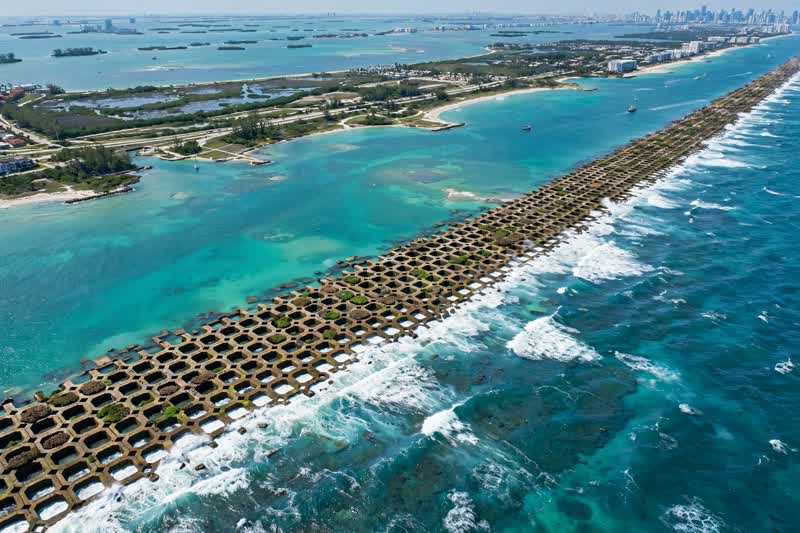
A 150-mile artificial reef matrix offshore of Miami and the Keys, built from 25 million tons of porous carbon-negative concrete blocks, designed to kill 90% of hurricane wave energy before it reaches shore — while doubling as marine habitat.
Pros
- Works with wave physics rather than against it — dissipation beats deflection for long coastlines.
- Artificial reefs demonstrably create marine habitat; this is coastal defense that grows an ecosystem.
- Carbon-negative concrete turns the structure into a carbon sink, not just a shield.
Cons
- 25 million tons of concrete is an almost incomprehensible production order — the supply chain doesn't exist.
- 150 miles of offshore construction in hurricane alley means the build site itself gets hit during construction.
- Wave attenuation of "90%" is a model number; real storms will find the gaps.
Feasibility: The concept is the most ecologically literate on the list — the Dutch "sand engine" and living-breakwater projects in Staten Island prove the principle. But the scale is off the charts: 25 million tons of specialty concrete would require a dedicated industrial buildout rivaling a small country's cement industry. Phase it over decades, not years.
Aerial mock-up: A 150-mile semi-submerged geometric matrix paralleling the Keys, porous blocks just below the surface breaking ocean swells into calm water before they reach shore.