
← Back to the Minerals hub & live price tracker
The minerals
beneath our feet.
The proposal: a Strategic Mineral Extraction & Stockpiling Command — 450,000 engineers mapping, mining, and stockpiling America's rare earths, lithium, cobalt, and titanium with directional deep-bore tunnels that leave the surface untouched, then buying the surplus into sovereign reserve vaults. This is what it would take, what it would cost, and whether it could actually happen.
Digging without a scar
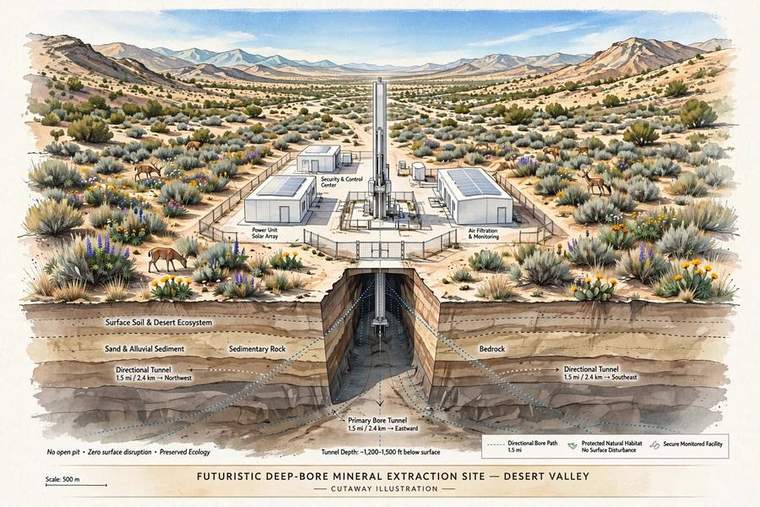
The SMESC proposal (Report 30) imagines the United States doing in five years what the mining industry normally does in fifty: aggressive high-resolution discovery and mapping of domestic rare earth elements, three years of saturating the domestic supply chain to build the 17,000-mile rail network, then a "Sovereign Purchase Loop" in years 4–5 buying all excess mineral output at a cost-plus-5% margin and funneling it into secure underground reserve vaults in the seismically quiet interior (Nevada, Utah). The signature engineering claim: no open pits. Extraction sites are small, secure surface facilities feeding 1.5-mile directional deep-bore subterranean tunnels — and any deposit near protected habitat or sacred land must be bored from at least 1.5 miles away horizontally, leaving the surface absolutely untouched.
The proposal, quantified
Figures are from Report 30 of the 30 Mega-Projects series. Target minerals include rare earth elements (neodymium, dysprosium), lithium, cobalt, and titanium — the inputs for EV motors, wind turbines, batteries, and aerospace alloys.
Pros & cons
The case for it
- The dependence is real and dangerous. The US imports the overwhelming majority of its rare earth elements — USGS data has consistently shown China dominating global production and processing, with the US effectively 100% import-reliant for years at a time. In 2010, China briefly restricted rare earth exports to Japan during a diplomatic dispute — a preview of what supply coercion looks like.
- America actually has the minerals. Mountain Pass in California is the only operating US rare earth mine, and for years its concentrate was shipped to China for processing — the US mined the ore and imported the finished magnets. Thacker Pass in Nevada holds one of the world's largest known lithium deposits and is now under development. The geology is not the problem.
- Clean energy runs on these metals. A single EV motor needs kilograms of neodymium and dysprosium; a wind turbine needs hundreds of kilograms; grid-scale batteries need lithium and cobalt. Every scenario for decarbonization — the IEA's included — shows mineral demand multiplying several-fold by 2040. Someone has to mine them.
- Stockpiling is proven policy. The US already maintains the Strategic Petroleum Reserve and the National Defense Stockpile for exactly this logic: buy critical materials in peacetime so shortages don't become crises. A mineral equivalent is an extension of existing doctrine, not an invention.
- Low-impact mining is a real engineering direction. Directional and borehole mining techniques genuinely do reduce surface disturbance compared to open pits, and the industry's best operators already backfill, restore, and monitor. The proposal's "no surface scar" standard is aspirational, but the trajectory is real.
The case against it
- Mines take 10–15 years, not 5. From discovery to production, a new mine averages well over a decade globally — permitting, environmental review, financing, construction, and commissioning each take years. The proposal's five-year timeline for discovery-through-stockpiling compresses an entire industry cycle into a single presidential term.
- Rare earth mining is chemically brutal. The elements occur at low concentrations mixed with radioactive thorium; separating them requires aggressive acid leaching that generates large volumes of toxic waste. China's Bayan Obo region carries a notorious legacy of contaminated soil and water. "No surface scar" doesn't cover what happens to the chemistry.
- 450,000 miners don't exist. The entire US mining workforce is roughly 600,000 people across all commodities. The proposal would need to conjure three-quarters of another mining industry — geologists, blasters, metallurgists, chemical engineers — essentially overnight, in a country with a shrinking mining labor pipeline.
- The purchase loop distorts the market it feeds. A government standing ready to buy all excess output at cost-plus-5% removes the price signal that tells miners what to dig. Surpluses get stockpiled instead of priced, and the "sovereign reserve" becomes a warehouse of metals bought above market with no exit strategy.
- Processing is the actual bottleneck, not mining. Mountain Pass proves it: the US can dig up rare earth ore today. What it can't do at scale is the separation and refining — the chemically intensive middle step China dominates. The proposal is heavy on extraction and light on the refineries that actually determine independence.
Could this actually be built?
The honest answer is: the goal is right and the schedule is fantasy. US mineral dependence on China is a genuine strategic vulnerability that both parties now acknowledge — the DOE's critical minerals list, the Defense Production Act invocations for battery materials, and the Thacker Pass and Mountain Pass developments all show the country is already moving in this direction, slowly.
But mining doesn't do five-year miracles. Permitting alone routinely takes 7–10 years in the US, the skilled workforce can't be conjured, and the hardest part — chemical separation and refining — gets barely a paragraph in the proposal. The 1.5-mile directional boring standard is a nice aspiration, but bulk minerals are not extracted like oil wells; the geology dictates the method, not the mandate.
The version with real precedent: a 15–20 year national minerals strategy — streamlined permitting, funded geological surveys, domestic refineries first, strategic stockpiles built gradually. That's roughly what Australia and Canada are doing. It just doesn't fit in a five-year sprint.
Verdict: strategically essential, geologically real, and about three times slower than proposed. Start with the refineries — that's where independence is actually won or lost.
What it would look like finished
"No open-pit surface scars exist. Extraction sites consist of small, highly secure surface facilities feeding into massive, 1.5-mile directional deep-bore subterranean tunnels, leaving the surface ecology entirely undisturbed."
— SME-30 aerial mock-up description, Foreign Labor & Deployment appendixYears 1–3 are domestic supply saturation using deep-bore directional methods, staffed by the proposal's 450,000-strong workforce of deep-rock mining engineers. Years 4–5 activate the Sovereign Purchase Loop and fill the underground reserve vaults in Nevada and Utah. Vault construction alone is estimated at roughly 200,000 truckloads of materials via the I-80 and I-15 corridors.
All cost and schedule figures on this page are the proposal's own estimates from the 30 Mega-Projects report series (Report 30), not independent appraisals. Real-world references — USGS import data, Mountain Pass, Thacker Pass, the Strategic Petroleum Reserve — are included so you can check the claims yourself.