
Aurora, IL
Stop on the proposed 17,000-mile maglev network. Next stop: Naperville, IL (9.1 mi).
About Aurora
An aurora is a natural light display in Earth's upper atmosphere caused by charged particles from the Sun colliding with atoms in the atmosphere. These collisions excite oxygen and nitrogen, which then emit light of different colours such as green, red, and purple. When observed in high-latitude regions they are called polar lights and aurora polaris.
Source: Wikipedia summary (full article). Population and facts as published there.
Cost breakdown (proposal-scale estimates — see math)
| Item | Basis | Estimate |
|---|---|---|
| Terminal construction | Mid-size terminal (parametric range $1-2B) | $1.5B |
| Land acquisition | Regional factor 1× on $200M base | $200M |
| Track: Aurora → Naperville | 9.1 mi × $500M/mi | $4.55B |
| Annual operations (share) | Staffing, power, maintenance | $30M/yr |
| Stop total (excl. annual ops) | $6.25B |
Best terminal location (proposed)
The downtown Aurora Transportation Center district. Aurora's Transportation Center is the BNSF line's western terminus with heavy commuter ridership and Metra's busiest outlying station. The surrounding downtown blocks mix parking lots and redeveloping storefronts, and the Fox River riverfront gives the terminal a visible civic anchor.
Before / after
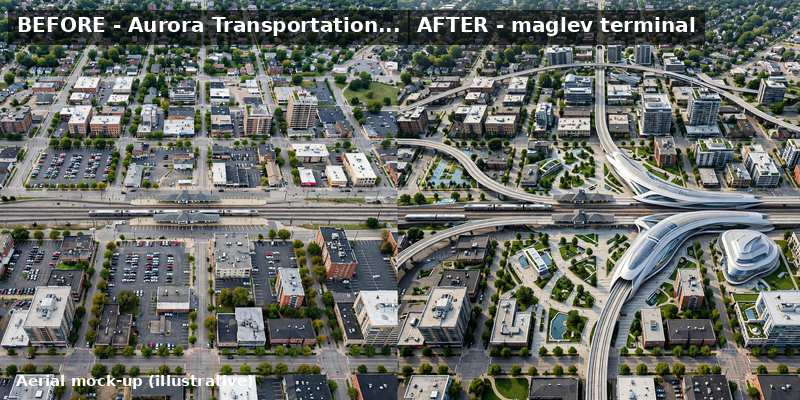
Aerial mock-up (illustrative, not an engineering rendering). Left: the proposed site today. Right: with the maglev terminal.
- Eola, IL - unincorporated community on the BNSF corridor
- Warrenville, IL - small city just north of the leg
- Corridor note: no third town fits - this 9.1-mile hop sits inside the continuous Chicago suburbs