
Charlotte, NC
Stop on the proposed 17,000-mile maglev network. Next stop: High Point, NC (69.0 mi).
About Charlotte
Charlotte is the most populous city in the U.S. state of North Carolina. With a population of 874,579 at the 2020 census, it is the 14th-most populous city in the U.S., seventh-most populous city in the South, and second-most populous city in the Southeast. The Charlotte metropolitan area, with an estimated 2.88 million residents, is the 21st-largest metropolitan area in the U.S. and lies at the center of an 18-county combined statistical area with an estimated population of 3.47 million as of 2024.
Source: Wikipedia summary (full article). Population and facts as published there.
Cost breakdown (proposal-scale estimates — see math)
| Item | Basis | Estimate |
|---|---|---|
| Terminal construction | Large city — metro tier (range $2–4B) | $3B |
| Land acquisition | Regional factor 1.5× on $200M base | $300M |
| Track: Charlotte → High Point | 69.0 mi × $500M/mi | $34.5B |
| Annual operations (share) | Staffing, power, maintenance | $60M/yr |
| Stop total (excl. annual ops) | $37.8B |
Best terminal location (proposed)
The Gateway Station district in Uptown. Charlotte's long-planned Gateway multimodal station site sits at the convergence of existing freight corridors, the LYNX Blue Line, and the regional bus network. Uptown's employment density would give the terminal the region's largest single demand catchment, and the corridor toward High Point follows established rail rights-of-way.
Before / after
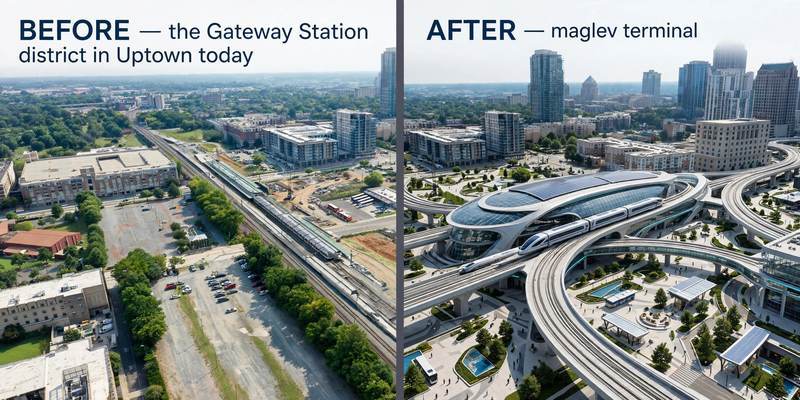
Aerial mock-up (illustrative, not an engineering rendering). Left: the proposed site today. Right: with the maglev terminal.
- Gastonia, NC — former textile-mill city on the I-85 corridor.
- Belmont, NC — historic mill town on the Catawba River.
- Kings Mountain, NC — gateway town at the I-85/US-74 split.