
Chesapeake, VA
Stop on the proposed 17,000-mile maglev network. Next stop: Norfolk, VA (5.7 mi).
About Chesapeake
Chesapeake is an independent city in Virginia, United States. At the 2020 census, the population was 249,422, making it the second-most populous city in Virginia, the tenth largest in the Mid-Atlantic, and the 92nd-most populous city in the United States.
Source: Wikipedia summary (full article). Population and facts as published there.
Cost breakdown (proposal-scale estimates — see math)
| Item | Basis | Estimate |
|---|---|---|
| Terminal construction | Large city — metro tier (range $2–4B) | $3B |
| Land acquisition | Regional factor 1.5× on $200M base | $300M |
| Track: Chesapeake → Norfolk | 5.7 mi × $500M/mi | $2.9B |
| Annual operations (share) | Staffing, power, maintenance | $60M/yr |
| Stop total (excl. annual ops) | $6.2B |
Best terminal location (proposed)
The Greenbrier commercial district at I-64/I-464. Greenbrier is South Hampton Roads' largest employment and retail center, with interstate access from every direction and room for a park-and-ride-scale facility. The site captures the region's fastest-growing suburbs and offers a straight corridor north toward Norfolk.
Before / after
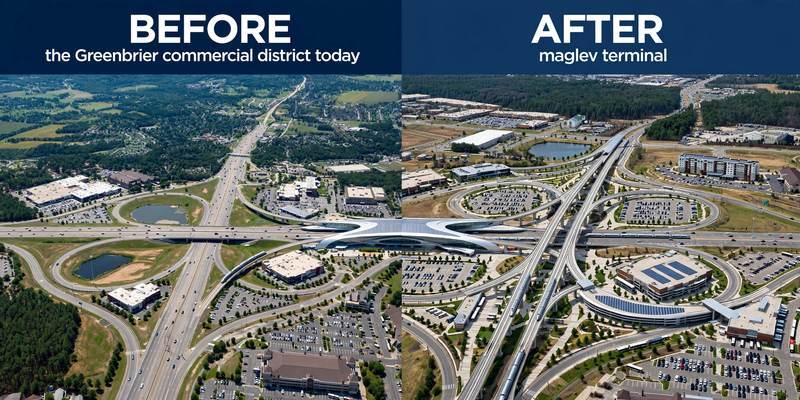
Aerial mock-up (illustrative, not an engineering rendering). Left: the proposed site today. Right: with the maglev terminal.
- South Norfolk (Chesapeake) — historic district on the rail line.
- Berkley (Norfolk) — waterfront neighborhood across the Eastern Branch.
- Deep Creek (Chesapeake) — residential area on the southern corridor.