
Chicago, IL
Stop on the proposed 17,000-mile maglev network. Next stop: Naperville, IL (27.5 mi).
About Chicago
Chicago is the most populous city in the U.S. state of Illinois and in the Midwestern United States. Located on the western shore of Lake Michigan, it is the third-most populous city in the United States and the fifth-most populous city in North America, with a population of 2.74 million at the 2020 census.
Source: Wikipedia summary (full article). Population and facts as published there.
Cost breakdown (proposal-scale estimates — see math)
| Item | Basis | Estimate |
|---|---|---|
| Terminal construction | Major-hub terminal (parametric range $4-8B) | $6B |
| Land acquisition | Regional factor 1.5× on $200M base | $300M |
| Track: Chicago → Naperville | 27.5 mi × $500M/mi | $13.75B |
| Annual operations (share) | Staffing, power, maintenance | $120M/yr |
| Stop total (excl. annual ops) | $20.05B |
Best terminal location (proposed)
The existing Union Station district in the West Loop. Union Station already anchors Amtrak, six Metra lines, and CTA buses in the densest transit catchment in the Midwest. Building the maglev terminal on air rights over the existing rail yard avoids new land assembly downtown, and the West Loop's office and residential density guarantees ridership from day one.
Before / after
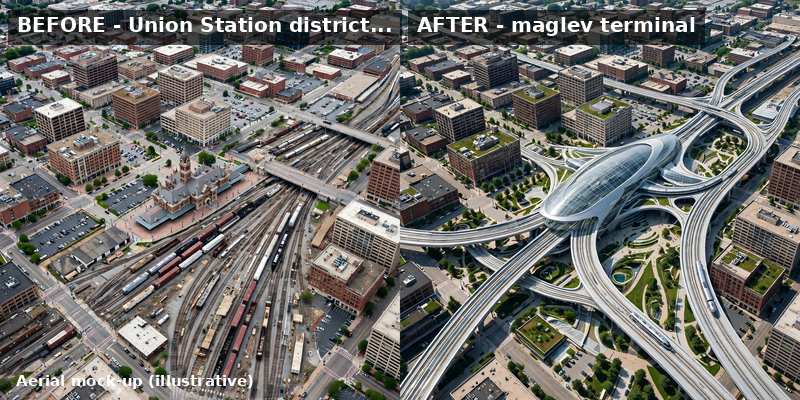
Aerial mock-up (illustrative, not an engineering rendering). Left: the proposed site today. Right: with the maglev terminal.
- Downers Grove, IL - established rail suburb on the BNSF corridor west of the Loop
- Westmont, IL - small commuter town on the Chicago-Naperville leg
- Lisle, IL - office-corridor suburb midway to Naperville