
Denver, CO
Stop on the proposed 17,000-mile maglev network. Next stop: Lakewood, CO (5.6 mi).
About Denver
Denver, officially the City and County of Denver, is the capital and most populous city of the U.S. state of Colorado. Officially a consolidated city and county, it is located in the South Platte River valley on the western edge of the High Plains, and is just east of the Front Range of the Rocky Mountains (Rockies).
Source: Wikipedia summary (full article). Population and facts as published there.
Cost breakdown (proposal-scale estimates — see math)
| Item | Basis | Estimate |
|---|---|---|
| Terminal construction | Large-city terminal (parametric range $2–4B) | $3B |
| Land acquisition | Regional factor 1.5× on $200M base | $300M |
| Track: Denver → Lakewood | 5.6 mi × $500M/mi | $2.8B |
| Annual operations (share) | Staffing, power, maintenance | $60M/yr |
| Stop total (excl. annual ops) | $6.1B |
Best terminal location (proposed)
Denver Union Station and the adjacent rail yards. Union Station is the undisputed transit heart of the metro — every RTD rail line, the A Line to the airport, Amtrak, and intercity buses converge there. The remaining rail-yard parcels around it are the only downtown land bank big enough for a maglev terminal, and the site already functions as the region's front door.
Before / after
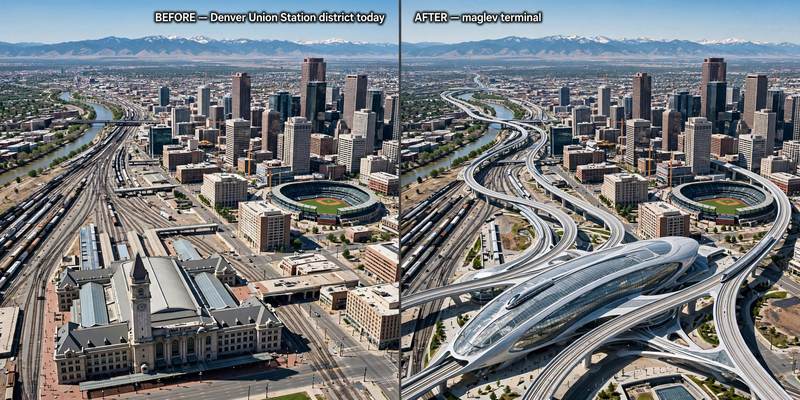
Aerial mock-up (illustrative, not an engineering rendering). Left: the proposed site today. Right: with the maglev terminal.
- Villa Park — west Denver neighborhood along the corridor to Lakewood.
- Edgewater — small lakefront city on Sloan's Lake.
- The Sloan's Lake corridor — infill serving the lake neighborhoods.