
Detroit, MI
Stop on the proposed 17,000-mile maglev network. Next stop: Warren, MI (11.2 mi).
About Detroit
Detroit is the most populous city in the U.S. state of Michigan. It is situated on the bank of the Detroit River across from the Canadian city of Windsor, Ontario.
Source: Wikipedia summary (full article). Population and facts as published there.
Cost breakdown (proposal-scale estimates — see math)
| Item | Basis | Estimate |
|---|---|---|
| Terminal construction | Large-city terminal (parametric range $2-4B) | $3B |
| Land acquisition | Regional factor 1.5× on $200M base | $300M |
| Track: Detroit → Warren | 11.2 mi × $500M/mi | $5.6B |
| Annual operations (share) | Staffing, power, maintenance | $60M/yr |
| Stop total (excl. annual ops) | $8.9B |
Best terminal location (proposed)
The Michigan Central Station district in Corktown. Ford's restored Michigan Central gives the corridor a landmark anchor with rehabbed headhouse space and surrounding Corktown parcels already being redeveloped. It connects to the QLine streetcar and I-75/I-96 freeway access, and Corktown's growth trajectory means a terminal lands in a rising district, not a stranded one.
Before / after
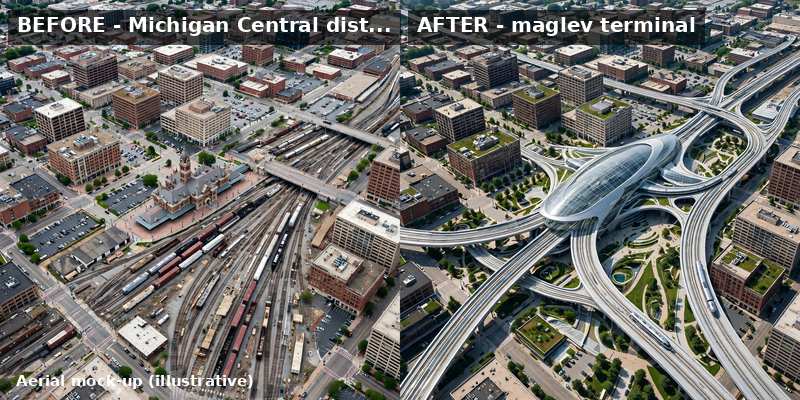
Aerial mock-up (illustrative, not an engineering rendering). Left: the proposed site today. Right: with the maglev terminal.
- Hamtramck, MI - dense enclave city directly north of downtown Detroit
- Hazel Park, MI - small suburb on the Dequindre corridor
- Center Line, MI - tiny enclave fully surrounded by Warren