
Durham, NC
Stop on the proposed 17,000-mile maglev network. Next stop: Cary, NC (15.5 mi).
About Durham
Durham is a city in the U.S. state of North Carolina, being the county seat of Durham County, with outskirts of the city limits also extending into Orange County and Wake County. Durham is the 4th-most populous city in North Carolina and 70th-most populous city in the United States with a population of 283,506 at the 2020 census. The four-county Durham–Chapel Hill metropolitan area has an estimated 620,000 residents, while the greater Research Triangle area has a population of over 2.37 million people.
Source: Wikipedia summary (full article). Population and facts as published there.
Cost breakdown (proposal-scale estimates — see math)
| Item | Basis | Estimate |
|---|---|---|
| Terminal construction | Mid-size city — metro tier (range $1–2B) | $1.5B |
| Land acquisition | Regional factor 1.5× on $200M base | $300M |
| Track: Durham → Cary | 15.5 mi × $500M/mi | $7.8B |
| Annual operations (share) | Staffing, power, maintenance | $30M/yr |
| Stop total (excl. annual ops) | $9.6B |
Best terminal location (proposed)
The downtown Durham station district (Brightleaf area). Durham's Amtrak station already anchors the downtown rail corridor, surrounded by the Brightleaf and American Tobacco redevelopment districts. The terminal would serve Duke and downtown employers plus Research Triangle commuters, sitting midway on the Raleigh–Greensboro corridor.
Before / after
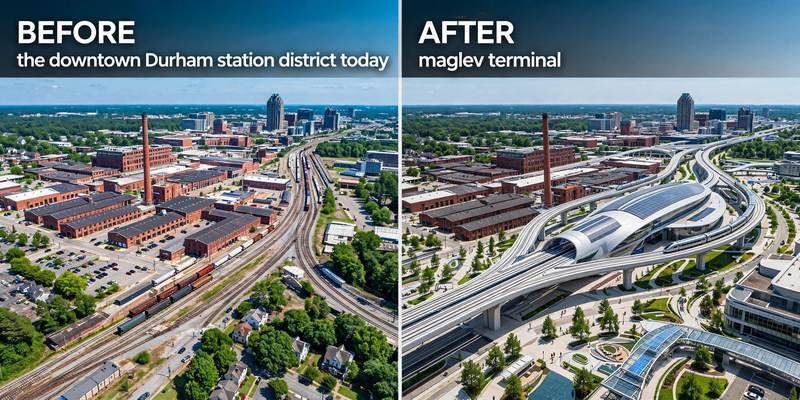
Aerial mock-up (illustrative, not an engineering rendering). Left: the proposed site today. Right: with the maglev terminal.
- Research Triangle Park — the region's flagship research campus.
- Morrisville, NC — fast-growing town on the NC-54 corridor.
- Brier Creek (Raleigh) — retail and office node on I-540.