
Erie, PA
Stop on the proposed 17,000-mile maglev network. Next stop: Buffalo, NY (80.7 mi).
About Erie
Erie is a city on the south shore of Lake Erie and the county seat of Erie County, Pennsylvania, United States. It is the fifth-most populous city in Pennsylvania and the most populous in Northwestern Pennsylvania with a population of 94,831 as of the 2020 census. The Erie metropolitan area had a population of 270,876 in 2020.
Source: Wikipedia summary (full article). Population and facts as published there.
Cost breakdown (proposal-scale estimates — see math)
| Item | Basis | Estimate |
|---|---|---|
| Terminal construction | Mid-size city terminal (parametric range $1–2B) | $1.5B |
| Land acquisition | Regional factor 1.0× on $200M base | $200M |
| Track: Erie → Buffalo | 80.7 mi × $500M/mi | $40.4B |
| Annual operations (share) | Staffing, power, maintenance | $30M/yr |
| Stop total (excl. annual ops) | $42.1B |
Best terminal location (proposed)
The downtown Union Station district. Erie's Union Station still serves Amtrak's Lake Shore Limited on the historic lakefront rail corridor, two blocks from the bayfront. The surrounding downtown blocks hold redevelopment parcels, and the site anchors Pennsylvania's only Great Lakes port city.
Before / after
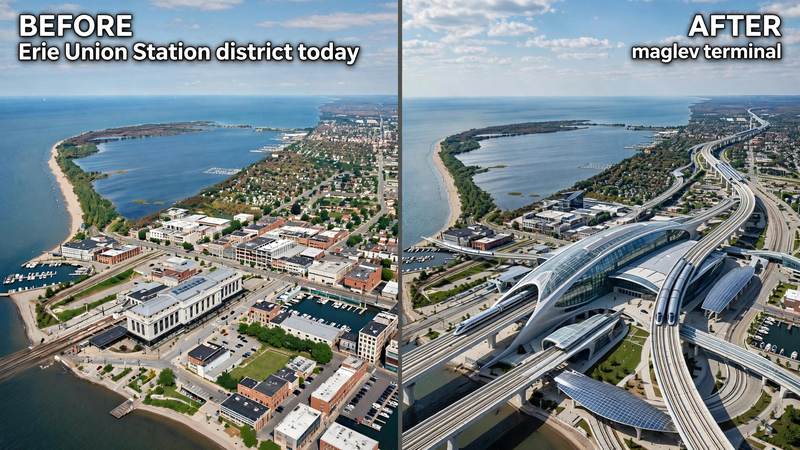
Aerial mock-up (illustrative, not an engineering rendering). Left: the proposed site today. Right: with the maglev terminal.
- North East, PA — lakefront wine-country town.
- Dunkirk, NY — Chautauqua County lake city.
- Fredonia, NY — SUNY college town.