
Houston, TX
Stop on the proposed 17,000-mile maglev network. Next stop: Pasadena, TX (10.5 mi).
About Houston
Houston is the most populous city in the U.S. state of Texas and the Southern United States. It is the fourth-most populous city in the United States, with a population of 2.3 million at the 2020 census.
Source: Wikipedia summary (full article). Population and facts as published there.
Cost breakdown (proposal-scale estimates — see math)
| Item | Basis | Estimate |
|---|---|---|
| Terminal construction | Major hub terminal — top-10 US metro ($4–8B range) | $6B |
| Land acquisition | Regional factor 1.2× on $200M base | $240M |
| Track: Houston → Pasadena | 10.5 mi × $500M/mi | $5.2B |
| Annual operations (share) | Staffing, power, maintenance | $120M/yr |
| Stop total (excl. annual ops) | $11.5B |
Best terminal location (proposed)
the existing Amtrak Houston station district at 902 Washington Ave, just northwest of downtown. It sits at the convergence of the I-10, I-45 and Hardy Toll Road corridors, so the whole metro can reach it. The site is already rail-served, with METRORail's Burnett Transit Center nearby for last-mile connections. A downtown-adjacent terminal captures both the central business district and the Galleria/Uptown demand core within minutes.
Before / after
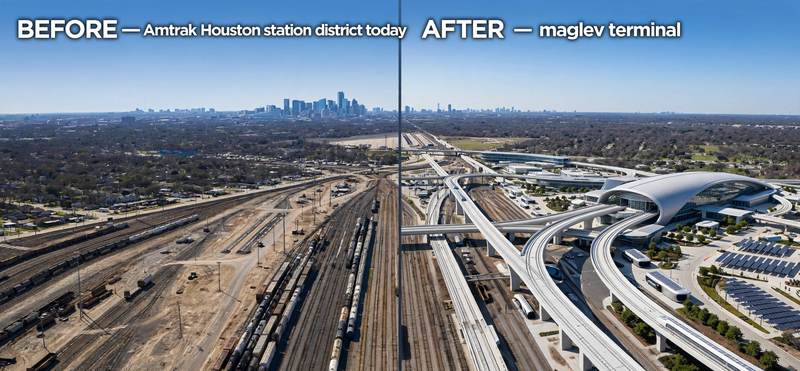
Aerial mock-up (illustrative, not an engineering rendering). Left: the proposed site today. Right: with the maglev terminal.
- Deer Park — petrochemical corridor town astride SH-225, serving the refinery workforce.
- La Porte — port-adjacent city on Galveston Bay, gateway to the Ship Channel.
- South Houston — working-class city on the I-45 corridor between the two terminals.