
Lancaster, CA
Stop on the proposed 17,000-mile maglev network. Next stop: Palmdale, CA (7.8 mi).
About Lancaster
Lancaster is a charter city in northern Los Angeles County, in the Antelope Valley of the western Mojave Desert in Southern California, United States. As of the 2020 census, the population was 173,516, making Lancaster the 158th-most populous city in the United States and the 31st most populous in California. Lancaster is a twin city with its southern neighbor Palmdale; together, they are the principal cities within the Antelope Valley region.
Source: Wikipedia summary (full article). Population and facts as published there.
Cost breakdown (proposal-scale estimates — see math)
| Item | Basis | Estimate |
|---|---|---|
| Terminal construction | Mid-size city terminal ($1–2B range) | $1.5B |
| Land acquisition | Regional factor 1.5× on $200M base | $300M |
| Track: Lancaster → Palmdale | 7.8 mi × $500M/mi | $3.9B |
| Annual operations (share) | 2% of $1.5B terminal | $30M/yr |
| Stop total (excl. annual ops) | $5.7B |
Best terminal location (proposed)
The Lancaster Metrolink station district. The Lancaster station is the northern terminus of Metrolink's Antelope Valley Line, in the city's historic downtown. The BLVD's revitalization has opened redevelopment parcels around the station. The catchment is the Antelope Valley's 450,000+ residents — classic super-commuters to LA — plus Plant 42's aerospace workforce, on some of the cheapest buildable land in LA County.
Before / after
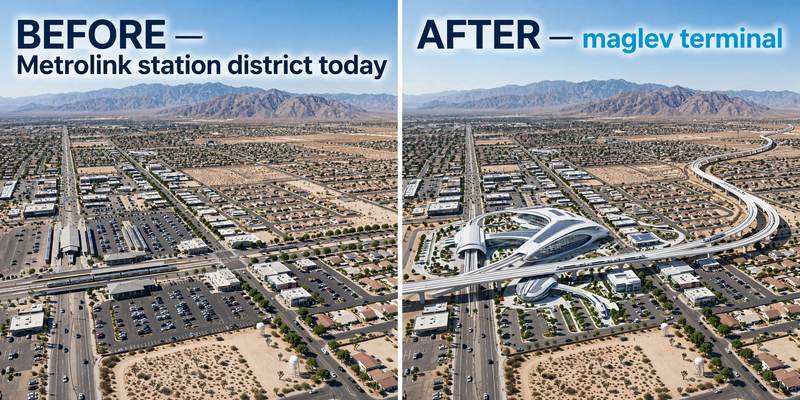
Aerial mock-up (illustrative, not an engineering rendering). Left: the proposed site today. Right: with the maglev terminal.
- Quartz Hill — unincorporated foothill community on the corridor.
- Avenue K corridor — commercial strip on the route to Palmdale.