
Lowell, MA
Stop on the proposed 17,000-mile maglev network. Next stop: Cambridge, MA (20.8 mi).
About Lowell
Lowell is a city in Massachusetts, United States. Alongside Cambridge, it is one of the two traditional seats of Middlesex County. With an estimated population of 115,554 in 2020, it was the fifth most populous city in Massachusetts as of the last census, and the third most populous in the Boston metropolitan statistical area.
Source: Wikipedia summary (full article). Population and facts as published there.
Cost breakdown (proposal-scale estimates — see math)
| Item | Basis | Estimate |
|---|---|---|
| Terminal construction | Mid-size terminal — 200K–1M catchment ($1–2B range) | $1.5B |
| Land acquisition | Regional factor 1.5× on $200M base | $300M |
| Track: Lowell → Cambridge | 20.8 mi × $500M/mi | $10.4B |
| Annual operations (share) | Staffing, power, maintenance | $30M/yr |
| Stop total (excl. annual ops) | $12.2B |
Best terminal location (proposed)
the Gallagher Transit Terminal district. The existing MBTA commuter rail terminus already draws Merrimack Valley commuters. UMass Lowell's 18,000 students sit nearby. US-3 and I-495 access pulls in the Nashua, NH spillover market too.
Before / after
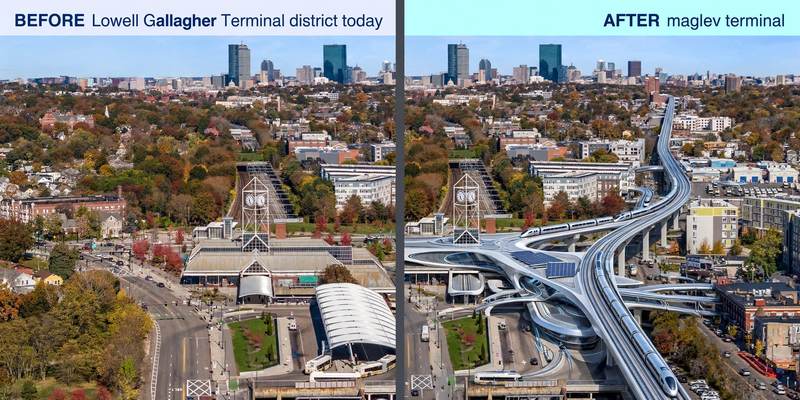
Aerial mock-up (illustrative, not an engineering rendering). Left: the proposed site today. Right: with the maglev terminal.
- Chelmsford — town on the corridor toward Boston.
- Burlington — town on the US-3 alignment.
- Woburn — city at the Cambridge approach.