
Oklahoma City, OK
Stop on the proposed 17,000-mile maglev network. Next stop: Norman, OK (17.3 mi).
About Oklahoma City
Oklahoma City, often shortened to OKC, is the capital and most populous city in the U.S. state of Oklahoma. It is the 21st-most populous U.S.
Source: Wikipedia summary (full article). Population and facts as published there.
Cost breakdown (proposal-scale estimates — see math)
| Item | Basis | Estimate |
|---|---|---|
| Terminal construction | Large-city terminal (parametric range $2–4B) | $3B |
| Land acquisition | Regional factor 1.0× on $200M base | $200M |
| Track: Oklahoma City → Norman | 17.3 mi × $500M/mi | $8.7B |
| Annual operations (share) | Staffing, power, maintenance | $60M/yr |
| Stop total (excl. annual ops) | $11.9B |
Best terminal location (proposed)
The Santa Fe Depot / downtown transit center district. The Santa Fe Depot hosts Amtrak's Heartland Flyer and sits beside EMBARK's downtown transit center, making it the natural intercity node. The surrounding Film Row and freight-rail parcels offer buildable land, and the site anchors the south end of the downtown renaissance around Scissortail Park.
Before / after
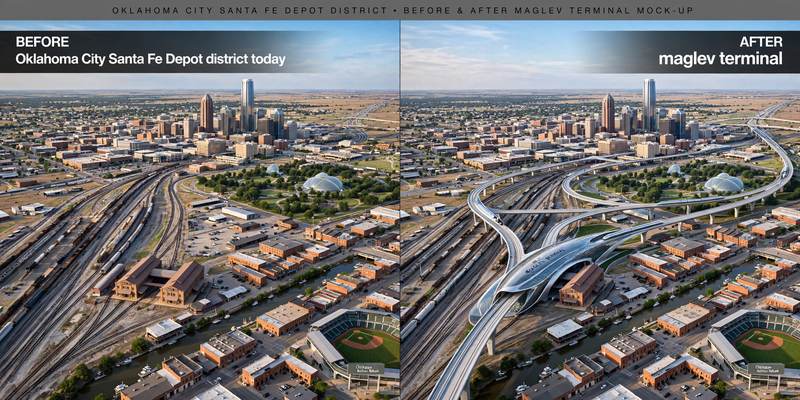
Aerial mock-up (illustrative, not an engineering rendering). Left: the proposed site today. Right: with the maglev terminal.
- Moore, OK — large suburb directly on the I-35 corridor to Norman.
- The Crossroads district — south OKC retail and employment hub.
- Valley Brook, OK — small town on the corridor.