
San Antonio, TX
Stop on the proposed 17,000-mile maglev network. Next stop: Austin, TX (73.7 mi).
About San Antonio
San Antonio is a city in the southern part of the U.S. state of Texas. It is the seventh-most populous city in the United States, the second-most populous city in Texas, and the second-most populous city in the Southern U.S., with a population of 1.43 million at the 2020 census.
Source: Wikipedia summary (full article). Population and facts as published there.
Cost breakdown (proposal-scale estimates — see math)
| Item | Basis | Estimate |
|---|---|---|
| Terminal construction | Large-city terminal — 1–4M metro ($2–4B range) | $3B |
| Land acquisition | Regional factor 1.2× on $200M base | $240M |
| Track: San Antonio → Austin | 73.7 mi × $500M/mi | $36.9B |
| Annual operations (share) | Staffing, power, maintenance | $60M/yr |
| Stop total (excl. annual ops) | $40.1B |
Best terminal location (proposed)
the existing Amtrak/Sunset Station district east of downtown, by the Alamodome. Historic rail yards are already in place, avoiding a greenfield land fight. VIA Metropolitan Transit's downtown hub is minutes away for bus connections. The site captures downtown, the Pearl district and the fast-growing near East Side in one catchment.
Before / after
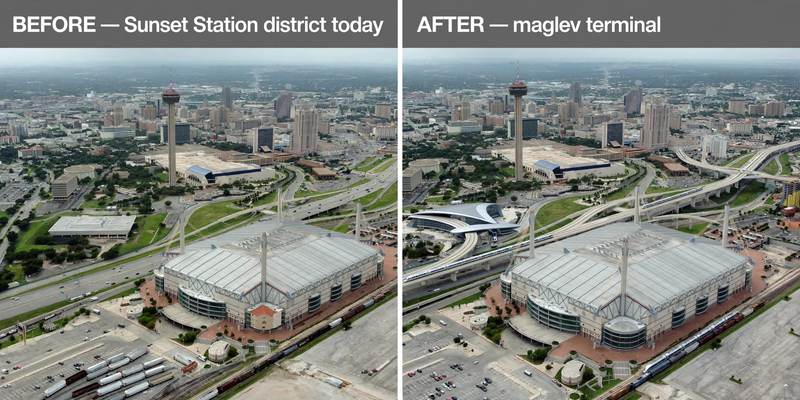
Aerial mock-up (illustrative, not an engineering rendering). Left: the proposed site today. Right: with the maglev terminal.
- New Braunfels — I-35 corridor city between the metros, Comal River tourism draw.
- San Marcos — Texas State University town and outlet-mall corridor stop.
- Kyle — one of the fastest-growing I-35 suburbs, pure commuter demand.