
San Francisco, CA
Stop on the proposed 17,000-mile maglev network. Next stop: Daly City, CA (6.6 mi).
About San Francisco
San Francisco, officially the City and County of San Francisco, is the 17th-largest city and second-densest major city in the United States, with a 2025 population of 826,079. It is the fourth-most populous city in California and the second most-populous in the Bay Area. Some 4.6 million residents live in the city's metropolitan statistical area.
Source: Wikipedia summary (full article). Population and facts as published there.
Cost breakdown (proposal-scale estimates — see math)
| Item | Basis | Estimate |
|---|---|---|
| Terminal construction | Major hub terminal ($4–8B range) | $6.0B |
| Land acquisition | Regional factor 1.5× on $200M base | $300M |
| Track: San Francisco → Daly City | 6.6 mi × $500M/mi | $3.3B |
| Annual operations (share) | 2% of $6.0B terminal | $120M/yr |
| Stop total (excl. annual ops) | $9.6B |
Best terminal location (proposed)
The Salesforce Transit Center district. The Transit Center was built with a train box in the basement specifically waiting for high-speed rail — the maglev terminal slots into infrastructure already designed for it. Its rooftop park and bus decks already handle tens of thousands of daily commuters. The Financial District and SoMa job cores are literally upstairs, the densest catchment on the West Coast.
Before / after
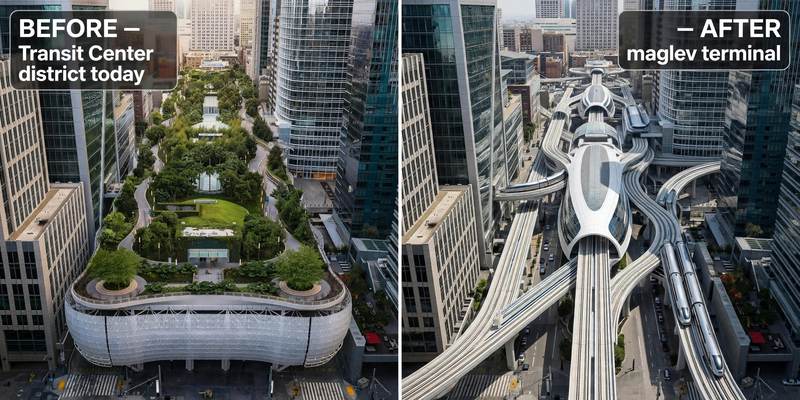
Aerial mock-up (illustrative, not an engineering rendering). Left: the proposed site today. Right: with the maglev terminal.
- Portola district — SF neighborhood along the Bayshore rail corridor.
- Visitacion Valley — hillside SF neighborhood on the southern approach.
- Bayshore / Daly City BART edge — BART interchange zone at the city-county line.