
San Jose, CA
Stop on the proposed 17,000-mile maglev network. Next stop: Santa Clara, CA (3.4 mi).
About San Jose
San Jose, officially the City of San José, is the most populous city in the San Francisco Bay Area and Northern California, and the 13th-most populous in the United States, with an estimated 989,814 residents as of 2025. The city's metropolitan area is home to nearly two million people, while the broader combined statistical area has a population of over nine million. Located in Santa Clara Valley on the southern shore of San Francisco Bay, San Jose covers an area of 179.97 sq mi (466.1 km2) and is the county seat of Santa Clara County.
Source: Wikipedia summary (full article). Population and facts as published there.
Cost breakdown (proposal-scale estimates — see math)
| Item | Basis | Estimate |
|---|---|---|
| Terminal construction | Major hub terminal ($4–8B range) | $6.0B |
| Land acquisition | Regional factor 1.5× on $200M base | $300M |
| Track: San Jose → Santa Clara | 3.4 mi × $500M/mi | $1.7B |
| Annual operations (share) | 2% of $6.0B terminal | $120M/yr |
| Stop total (excl. annual ops) | $8.0B |
Best terminal location (proposed)
The San Jose Diridon Station district. Diridon is the Bay Area's busiest rail hub — Caltrain, Amtrak Capitol Corridor, ACE, and VTA light rail already meet here, with BART's extension arriving next. The approved California HSR station box sits at the same site, so the maglev terminal can share approaches. The catchment is Silicon Valley itself: millions of tech commuters with no fast intercity option today.
Before / after
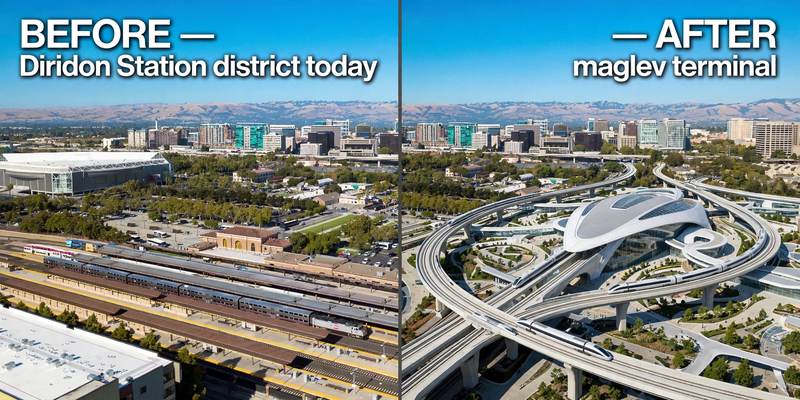
Aerial mock-up (illustrative, not an engineering rendering). Left: the proposed site today. Right: with the maglev terminal.
- Coleman Avenue corridor — office and retail strip west of Diridon along the rail line.
- Mineta San Jose Airport south edge — airport-connector station for SJC.
- Santa Clara University district — university and historic mission neighborhood.