
Seattle, WA
Stop on the proposed 17,000-mile maglev network. Next stop: Bellevue, WA (6.3 mi).
About Seattle
Seattle is the most populous city in the U.S. state of Washington and the Pacific Northwest region of North America. It is the 18th-most populous city in the United States with a population of 784,777 in 2025, while the Seattle metropolitan area at over 4.15 million residents is the 15th-most populous metropolitan area in the nation.
Source: Wikipedia summary (full article). Population and facts as published there.
Cost breakdown (proposal-scale estimates — see math)
| Item | Basis | Estimate |
|---|---|---|
| Terminal construction | Major hub terminal (range $4–8B) | $6B |
| Land acquisition | Regional factor 1.5× on $200M base | $300M |
| Track: Seattle → Bellevue | 6.3 mi × $500M/mi | $3.2B |
| Annual operations (share) | Staffing, power, maintenance | $120M/yr |
| Stop total (excl. annual ops) | $9.5B |
Best terminal location (proposed)
the King Street Station / Stadium district intermodal hub. King Street already stacks Amtrak Cascades, Sounder, Link light rail and streetcars beside downtown Seattle's stadiums — the natural northern anchor of the whole spine. The stadium district has the large parcels a major-hub terminal demands. It captures the entire Puget Sound region's intercity travel.
Before / after
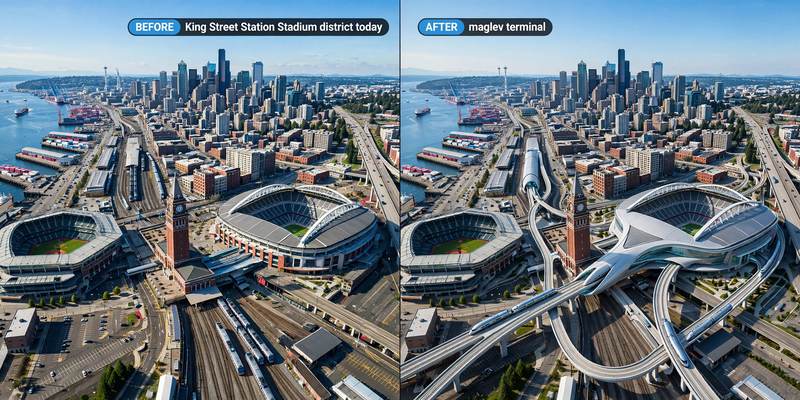
Aerial mock-up (illustrative, not an engineering rendering). Left: the proposed site today. Right: with the maglev terminal.
- Mercer Island — island suburb on I-90 directly between the two downtowns.
- Bellevue's Enatai neighborhood — waterfront residential area at the corridor's east landing.