
St. Petersburg, FL
Stop on the proposed 17,000-mile maglev network. Next stop: Clearwater, FL (16.3 mi).
About St. Petersburg
Saint Petersburg, formerly known as Petrograd (Петроград), and later Leningrad (Ленинград), is the second-largest city in Russia, after Moscow, the nation's capital. Situated on the Neva River at the head of the Gulf of Finland on the Baltic Sea, its area of 1,439 square kilometers (556 sq mi) makes it the smallest administrative division of Russia by area. The city had a population of 5,601,911 residents as of 2021, with more than 6.4 million people living in the metropolitan area.
Source: Wikipedia summary (full article). Population and facts as published there.
Cost breakdown (proposal-scale estimates — see math)
| Item | Basis | Estimate |
|---|---|---|
| Terminal construction | Large city — metro tier (range $2–4B) | $3B |
| Land acquisition | Regional factor 1.5× on $200M base | $300M |
| Track: St. Petersburg → Clearwater | 16.3 mi × $500M/mi | $8.2B |
| Annual operations (share) | Staffing, power, maintenance | $60M/yr |
| Stop total (excl. annual ops) | $11.4B |
Best terminal location (proposed)
The Tropicana Field / Gas Plant redevelopment district. The 86-acre Tropicana Field redevelopment is the largest single developable site in the urban core, with city plans already envisioning transit-oriented density. It sits minutes from downtown's waterfront employment and would anchor the Pinellas side of the bay crossing with genuine transit-oriented potential.
Before / after
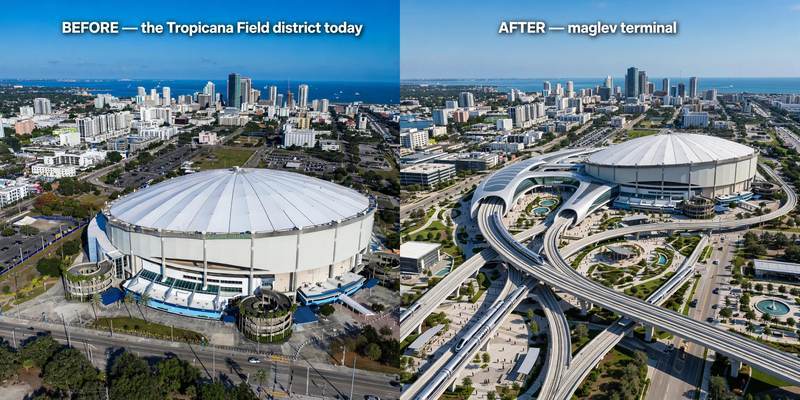
Aerial mock-up (illustrative, not an engineering rendering). Left: the proposed site today. Right: with the maglev terminal.
- Pinellas Park, FL — mid-county city on the US-19 corridor.
- Largo, FL — Pinellas County's third-largest city.
- Seminole, FL — residential and commercial hub on Park Boulevard.