
Visalia, CA
Stop on the proposed 17,000-mile maglev network. Next stop: Fresno, CA (39.3 mi).
About Visalia
Visalia is a city in the agricultural San Joaquin Valley of California. The population was 141,384 as per the 2020 census. Visalia is the fifth-most populous city in the San Joaquin Valley, the 38th most populous in California, and 183rd in the United States.
Source: Wikipedia summary (full article). Population and facts as published there.
Cost breakdown (proposal-scale estimates — see math)
| Item | Basis | Estimate |
|---|---|---|
| Terminal construction | Mid-size terminal (range $1–2B) | $1.5B |
| Land acquisition | Regional factor 1.5× on $200M base | $300M |
| Track: Visalia → Fresno | 39.3 mi × $500M/mi | $19.7B |
| Annual operations (share) | Staffing, power, maintenance | $30M/yr |
| Stop total (excl. annual ops) | $21.5B |
Best terminal location (proposed)
the downtown Visalia transit center district. Downtown Visalia is the Tulare County seat and its bus network hub, sitting astride SR-99, the Central Valley's main artery. The city has the valley's most developable downtown-adjacent land of any stop on this leg. It captures the farm, packing and logistics workforce of the southern San Joaquin Valley.
Before / after
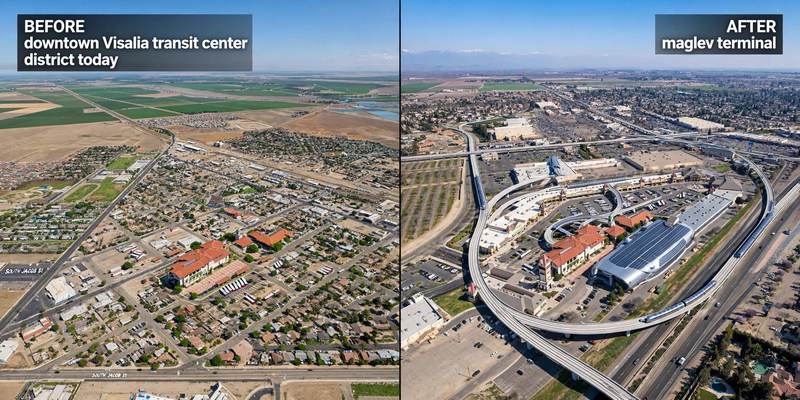
Aerial mock-up (illustrative, not an engineering rendering). Left: the proposed site today. Right: with the maglev terminal.
- Goshen — small farm town on SR-99 just north of Visalia.
- Kingsburg — the 'Swedish Village' on the 99 corridor, with a commuter catchment.
- Selma — the 'Raisin Capital,' midway on SR-99.
- Fowler — small city on the corridor's north approach to Fresno.