Chesapeake Bay, VA · $130B (proposal)
CHB-5 · Chesapeake Bay Gateway Lock Network
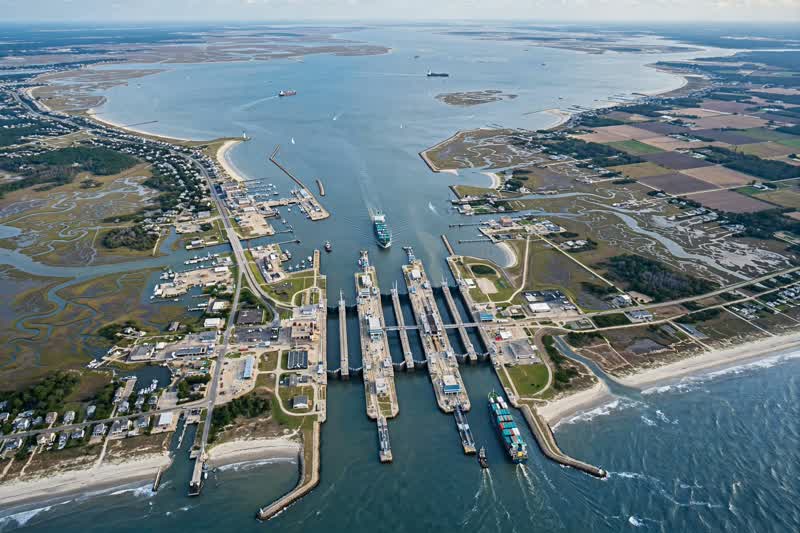
A network of low-profile hydraulic locks across the mouth of the Chesapeake Bay that would hold the bay's interior water level steady regardless of Atlantic tides or surges — essentially turning the largest estuary in America into a managed lake with a shipping door.
Pros
- Protects the entire Chesapeake watershed — Baltimore, Norfolk, Annapolis, and vast farmland — with one system.
- Lock technology is ancient, proven, and maintainable; this is scale, not invention.
- A stable interior water level would simplify every waterfront adaptation project upstream.
Cons
- The mouth of the bay is a critical Navy transit route — Hampton Roads shipyards cannot tolerate closures.
- Locking an estuary changes its ecology fundamentally; the Chesapeake's fisheries and salinity balance are at stake.
- Corrosion in brackish water destroys marine alloys fast; maintenance would be a permanent mega-expense.
Feasibility: Technically buildable — the Dutch Eastern Scheldt barrier is a working precedent for a storm-surge barrier that preserves tidal flow. But the ecological cost of semi-permanently locking an estuary this large has no precedent, and the Navy's operational veto is likely decisive. Feasible as engineering, doubtful as policy.
Aerial mock-up: A sprawling geometric grid of hydraulic locks crossing the bay mouth, warships and cargo vessels passing through dedicated central gates while calm water sits behind the barrier.