Penobscot Bay, Maine · $85B proposed
North Atlantic Gateway
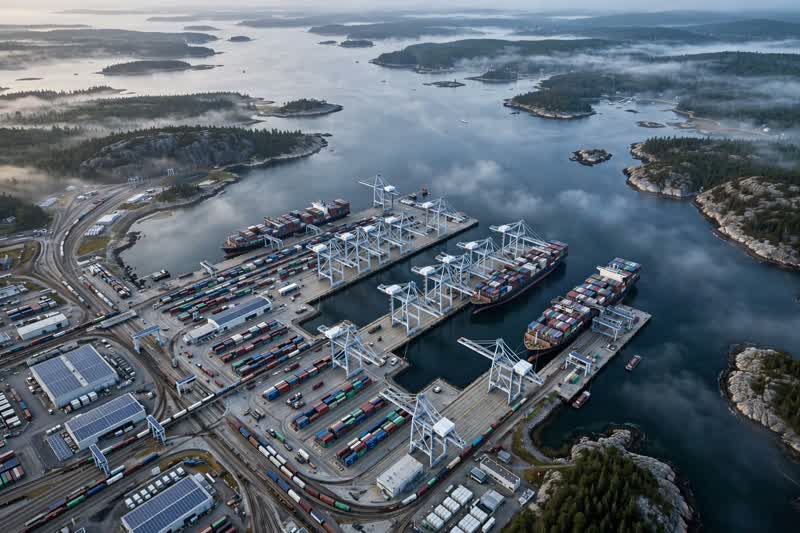
A greenfield deepwater container port carved into Penobscot Bay, aimed at capturing northern European shipping loops before they reach New York — with automated rail spurs feeding cargo straight into the Northeast Corridor.
Pros
- Geographically the closest US mainland point to northern Europe, shaving ~1 day off transatlantic crossings versus New York.
- Greenfield site means no legacy congestion — automation and 24-meter berths designed in from day one.
- Could relieve pressure on the chronically congested NY/NJ complex.
Cons
- Penobscot Bay has no existing container infrastructure; Portland, Maine handles a negligible ~50,000 TEU/year. There is no cargo base.
- Sub-arctic winter ice and storms would shut down or slow operations for months — a brutal reliability problem for scheduled liner services.
- Bedrock blasting in a pristine bay guarantees a decade-plus of environmental litigation under NEPA and the Clean Water Act.
Feasibility: Very low as a container mega-port. No container ship afloat draws 24 meters (the largest draw ~16m), so the headline spec is pure over-engineering. For comparison, Savannah's entire harbor deepening to 47 feet cost roughly $1 billion and took over a decade — Maine would be starting from zero, in ice, on bedrock. Plausible as a modest regional bulk port; fantasy as a $85B European gateway.
Aerial mock-up: Eco-quay structures mounted on concrete pylons over the deep natural channel, automated gantries rising above the bay's island-dotted waters.