Offshore Miami · $115B proposed
Straits of Florida Terminus
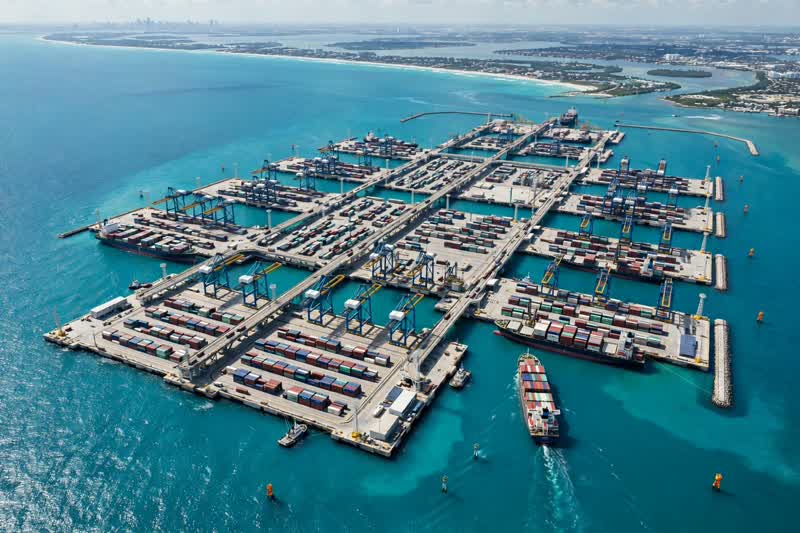
An offshore concrete grid platform in the Florida Straits — a transshipment hub linking Caribbean trade directly to high-speed rail, shielded by an artificial reef breakwater.
Pros
- Miami is already a major cruise and cargo port (~1.1M TEU) with genuine Caribbean transshipment traffic.
- An offshore hub could bypass the draft and air-draft limits of the existing harbor.
- The artificial-reef breakwater doubles as marine habitat — a rare case where the mitigation is itself an asset.
Cons
- The Florida Straits carry the Gulf Stream plus full hurricane exposure. No major container port on Earth operates on an exposed open-ocean platform in a hurricane zone.
- Offshore container handling in ocean swell is a solved problem nowhere — the physics of loading boxes in 3-meter seas doesn't care about budgets.
- The existing Port of Miami Tunnel ($1B) already solved the port's access problem; this duplicates it at 100x the cost.
Feasibility: Very low. This is the proposal most at war with physics. Ports exist in harbors for a reason — the ocean is violent, and the Florida Straits are among the most energetic waters in the Atlantic. A $115B platform that can't load containers during the six-month hurricane season is a monument, not a port.
Aerial mock-up: Massive continuous offshore automated concrete podiums extending over the Straits, fed by double-track AGV container rails.