
Albuquerque, NM
Stop on the proposed 17,000-mile maglev network. Next stop: Las Cruces, NM (193.0 mi).
About Albuquerque
Albuquerque is the most populous city in the U.S. state of New Mexico. Founded in 1706 as La Villa de Alburquerque by Santa Fe de Nuevo México governor Francisco Cuervo y Valdés, and named in honor of Francisco Fernández de la Cueva, 10th Duke of Alburquerque and Viceroy of New Spain, it was an outpost on El Camino Real, linking Mexico City to the northernmost territories of New Spain.
Source: Wikipedia summary (full article). Population and facts as published there.
Cost breakdown (proposal-scale estimates — see math)
| Item | Basis | Estimate |
|---|---|---|
| Terminal construction | Mid-size city terminal (parametric range $1–2B) | $1.5B |
| Land acquisition | Regional factor 0.7× on $200M base | $140M |
| Track: Albuquerque → Las Cruces | 193.0 mi × $500M/mi | $96.5B |
| Annual operations (share) | Staffing, power, maintenance | $30M/yr |
| Stop total (excl. annual ops) | $98.1B |
Best terminal location (proposed)
The Alvarado Transportation Center district downtown. Alvarado already unites the Rail Runner commuter line, Amtrak, and ABQ Ride buses under one roof — the state's only true intermodal hub. The adjacent rail yards and Barelas industrial blocks provide expansion room, and the site sits at the geographic center of the metro.
Before / after
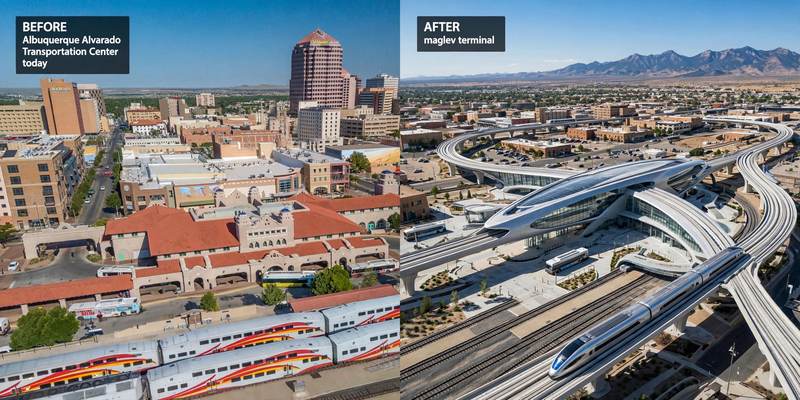
Aerial mock-up (illustrative, not an engineering rendering). Left: the proposed site today. Right: with the maglev terminal.
- Belen, NM — Valencia County rail town on the I-25 corridor.
- Socorro, NM — university town (New Mexico Tech) on the Rio Grande.
- Truth or Consequences, NM — spa resort town on Elephant Butte.