
Aurora, CO
Stop on the proposed 17,000-mile maglev network. Next stop: Denver, CO (8.2 mi).
About Aurora
Aurora is a home rule city located in Arapahoe, Adams, and Douglas counties, Colorado, United States. The city's population was 386,261 at the 2020 census, with 336,035 in Arapahoe County, 47,720 in Adams County, and 2,506 in Douglas County. It is the third-most-populous city in the state of Colorado and the 50th-most-populous city in the United States as of 2025.
Source: Wikipedia summary (full article). Population and facts as published there.
Cost breakdown (proposal-scale estimates — see math)
| Item | Basis | Estimate |
|---|---|---|
| Terminal construction | Mid-size city terminal (parametric range $1–2B) | $1.5B |
| Land acquisition | Regional factor 1.0× on $200M base | $200M |
| Track: Aurora → Denver | 8.2 mi × $500M/mi | $4.1B |
| Annual operations (share) | Staffing, power, maintenance | $30M/yr |
| Stop total (excl. annual ops) | $5.8B |
Best terminal location (proposed)
The Fitzsimons / Anschutz medical campus transit hub area. The Anschutz Medical Campus is the metro's largest employment center outside downtown, already served by the R Line light rail with a dedicated station. The former Fitzsimons grounds still hold developable parcels, and the site sits minutes from the airport corridor.
Before / after
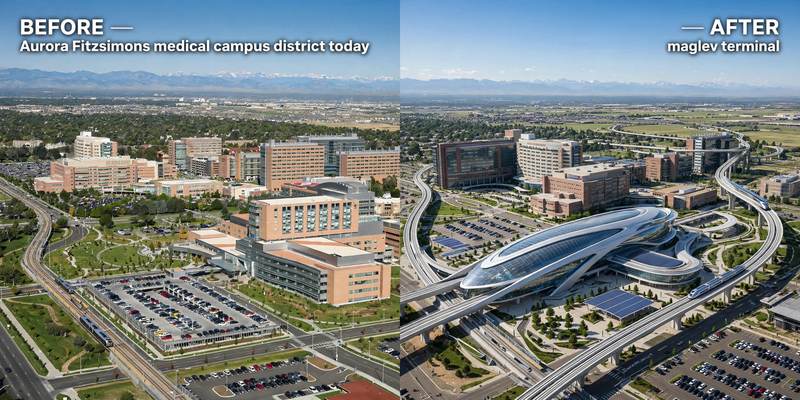
Aerial mock-up (illustrative, not an engineering rendering). Left: the proposed site today. Right: with the maglev terminal.
- The Fitzsimons redevelopment zone — campus-adjacent infill.
- The Havana corridor — north-south commercial spine.
- Central Park (Stapleton) — large redeveloped neighborhood to the west.