
Baton Rouge, LA
Stop on the proposed 17,000-mile maglev network. Next stop: Lafayette, LA (54.9 mi).
About Baton Rouge
Baton Rouge is the capital city of the U.S. state of Louisiana. It had a population of 227,470 at the 2020 United States census, making it Louisiana's second-most populous city.
Source: Wikipedia summary (full article). Population and facts as published there.
Cost breakdown (proposal-scale estimates — see math)
| Item | Basis | Estimate |
|---|---|---|
| Terminal construction | Mid-size city terminal (parametric range $1–2B) | $1.5B |
| Land acquisition | Regional factor 1.0× on $200M base | $200M |
| Track: Baton Rouge → Lafayette | 54.9 mi × $500M/mi | $27.4B |
| Annual operations (share) | Staffing, power, maintenance | $30M/yr |
| Stop total (excl. annual ops) | $29.1B |
Best terminal location (proposed)
The downtown riverfront near the former KCS rail yard. The riverfront rail yards below the State Capitol offer the only large flat parcels downtown, with the I-10 Mississippi bridge and the CATS bus hub minutes away. A terminal here serves LSU, state government, and the petrochemical corridor workforce in one stop.
Before / after
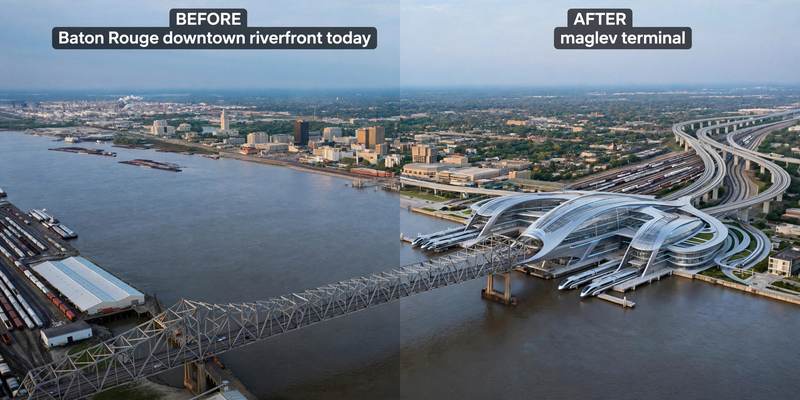
Aerial mock-up (illustrative, not an engineering rendering). Left: the proposed site today. Right: with the maglev terminal.
- Port Allen, LA — West Baton Rouge parish seat across the river.
- Grosse Tete, LA — small town on the I-10 corridor.
- Henderson, LA — Atchafalaya Basin town on the route west.