
Boulder, CO
Stop on the proposed 17,000-mile maglev network. Next stop: Westminster, CO (17.5 mi).
About Boulder
Boulder is a home rule city that is the county seat of, and the most populous municipality in, Boulder County, Colorado, United States. With a population of 108,250 at the 2020 census, it is the 12th-most populous city in Colorado. Boulder is the primary city of the Boulder metropolitan area, which had 330,758 residents in 2020, and is part of the Front Range Urban Corridor.
Source: Wikipedia summary (full article). Population and facts as published there.
Cost breakdown (proposal-scale estimates — see math)
| Item | Basis | Estimate |
|---|---|---|
| Terminal construction | Small-city terminal (parametric range $0.5–1B) | $0.75B |
| Land acquisition | Regional factor 0.7× on $200M base | $140M |
| Track: Boulder → Westminster | 17.5 mi × $500M/mi | $8.8B |
| Annual operations (share) | Staffing, power, maintenance | $15M/yr |
| Stop total (excl. annual ops) | $9.6B |
Best terminal location (proposed)
The Boulder Junction / Pearl Street corridor. Boulder Junction is the city's purpose-built transit hub, uniting regional buses, the Flatiron Flyer BRT, and bike-share beside the rail corridor. The surrounding redevelopment parcels are Boulder's only large transit-oriented sites, serving the university and the federal labs.
Before / after
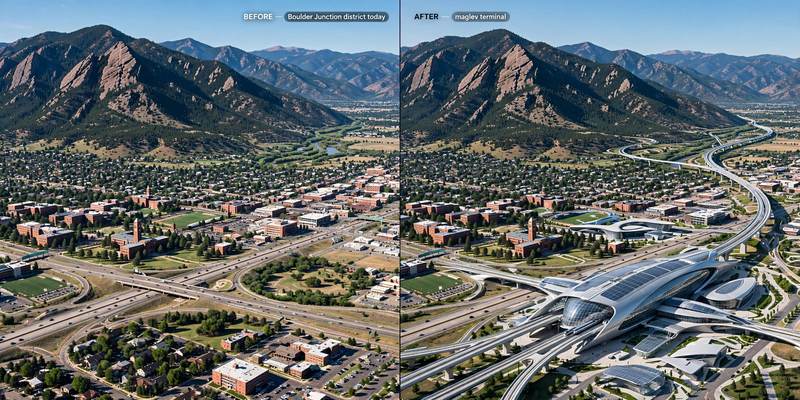
Aerial mock-up (illustrative, not an engineering rendering). Left: the proposed site today. Right: with the maglev terminal.
- Louisville, CO — small city on the US-36 corridor.
- Broomfield, CO — halfway municipality.
- Superior, CO — town on the corridor.