
Cape Coral, FL
Stop on the proposed 17,000-mile maglev network. Next stop: St. Petersburg, FL (93.7 mi).
About Cape Coral
Cape Coral is a city in Lee County, Florida, United States, on the Gulf of Mexico. Founded in 1957, the city's population had grown to 194,016 as of the 2020 census, a 26% increase from 154,309 at the 2010 census, making it the ninth-most populous city in Florida. With an area of 120 square miles (310 km2), Cape Coral is the largest city between Tampa and Miami in both population and area.
Source: Wikipedia summary (full article). Population and facts as published there.
Cost breakdown (proposal-scale estimates — see math)
| Item | Basis | Estimate |
|---|---|---|
| Terminal construction | Mid-size city — metro tier (range $1–2B) | $1.5B |
| Land acquisition | Regional factor 1.0× on $200M base | $200M |
| Track: Cape Coral → St. Petersburg | 93.7 mi × $500M/mi | $46.9B |
| Annual operations (share) | Staffing, power, maintenance | $30M/yr |
| Stop total (excl. annual ops) | $48.6B |
Best terminal location (proposed)
The Del Prado Boulevard corridor at Veterans Memorial Parkway. Del Prado is Cape Coral's main commercial spine, with the Veterans Parkway interchange offering the city's best highway access and room for a park-and-ride facility. The terminal would serve Southwest Florida's large retiree and service workforce and the US-41 corridor north toward St. Petersburg.
Before / after
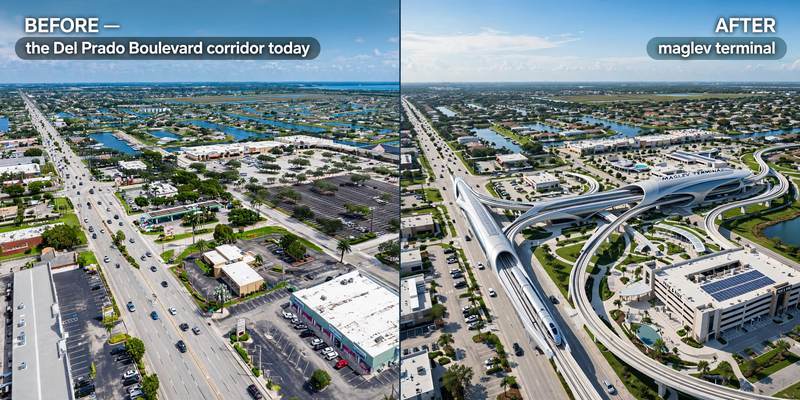
Aerial mock-up (illustrative, not an engineering rendering). Left: the proposed site today. Right: with the maglev terminal.
- Fort Myers, FL — Lee County seat across the Caloosahatchee River.
- Punta Gorda, FL — Charlotte County seat on US-41.
- Sarasota, FL — cultural and tourism hub on the Gulf Coast.