
Colorado Springs, CO
Stop on the proposed 17,000-mile maglev network. Next stop: Pueblo, CO (41.6 mi).
About Colorado Springs
Colorado Springs is a home rule city that is the county seat of and the most populous city in El Paso County, Colorado, United States. The city had a population of 478,961 at the 2020 census, a 15.02% increase since 2010. Colorado Springs is the second-most populous city and most extensive city by area in the state of Colorado, and the 40th-most-populous city in the United States.
Source: Wikipedia summary (full article). Population and facts as published there.
Cost breakdown (proposal-scale estimates — see math)
| Item | Basis | Estimate |
|---|---|---|
| Terminal construction | Mid-size city terminal (parametric range $1–2B) | $1.5B |
| Land acquisition | Regional factor 1.0× on $200M base | $200M |
| Track: Colorado Springs → Pueblo | 41.6 mi × $500M/mi | $20.8B |
| Annual operations (share) | Staffing, power, maintenance | $30M/yr |
| Stop total (excl. annual ops) | $22.5B |
Best terminal location (proposed)
A greenfield site at the I-25 / Nevada Avenue corridor south of downtown. The I-25 frontage south of downtown offers the only large, flat, highway-visible parcels near the city center, with direct access for Peterson Space Force Base and Schriever commuters. Mountain Metro's planned transit extensions can be routed to meet it, and it avoids the constrained downtown canyon.
Before / after
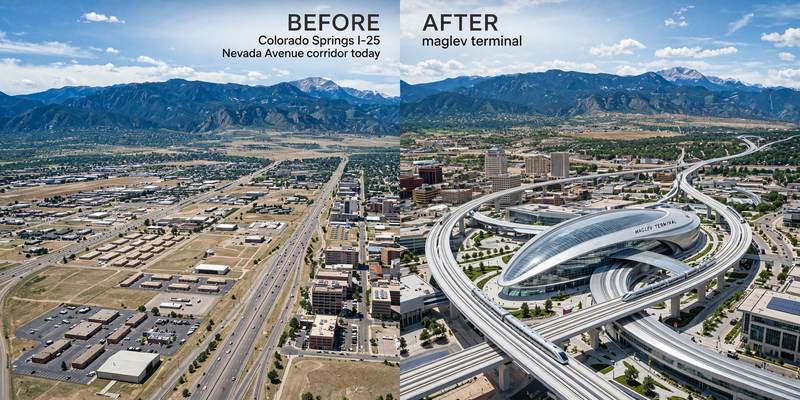
Aerial mock-up (illustrative, not an engineering rendering). Left: the proposed site today. Right: with the maglev terminal.
- Fountain, CO — military-adjacent suburb south on I-25.
- Security-Widefield, CO — unincorporated community on the corridor.
- The Pikes Peak International Raceway area — exurban infill south of Fountain.