
Costa Mesa, CA
Stop on the proposed 17,000-mile maglev network. Next stop: Huntington Beach, CA (4.8 mi).
About Costa Mesa
Costa Mesa is a city in Orange County, California, United States. Since its incorporation in 1953, the city has grown from a semi-rural farming community of 16,840 to an urban area including part of the South Coast Plaza–John Wayne Airport edge city, one of the region's largest commercial clusters, with an economy based on retail, commerce, and light manufacturing. The population was 111,918 at the 2020 census.
Source: Wikipedia summary (full article). Population and facts as published there.
Cost breakdown (proposal-scale estimates — see math)
| Item | Basis | Estimate |
|---|---|---|
| Terminal construction | Large-city terminal (range $2–4B) | $3B |
| Land acquisition | Regional factor 1.5× on $200M base | $300M |
| Track: Costa Mesa → Huntington Beach | 4.8 mi × $500M/mi | $2.4B |
| Annual operations (share) | Staffing, power, maintenance | $60M/yr |
| Stop total (excl. annual ops) | $5.7B |
Best terminal location (proposed)
the South Coast Metro / Harbor Boulevard transit corridor. South Coast Metro is Orange County's densest jobs-and-retail cluster, and Harbor Boulevard's bus corridor already carries the county's heaviest ridership. The corridor has the commercial frontage for a terminal footprint. It captures the coastal and central county workforce plus the region's tourism demand.
Before / after
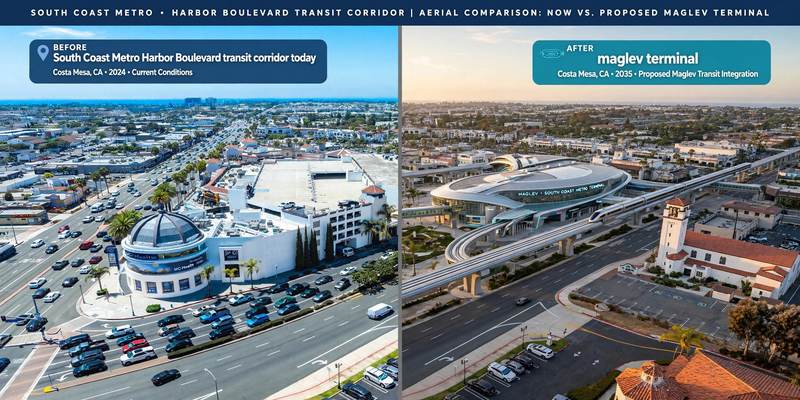
Aerial mock-up (illustrative, not an engineering rendering). Left: the proposed site today. Right: with the maglev terminal.
- The Adams Avenue corridor — commercial strip on the city boundary.
- Huntington Beach's Oak View district — dense residential area on the corridor.