
Huntington Beach, CA
Stop on the proposed 17,000-mile maglev network. Next stop: Costa Mesa, CA (4.8 mi).
About Huntington Beach
Huntington Beach is a city in Orange County, California, United States. The city was originally called Pacific City, but it was changed in 1903 to be named after American businessman Henry E. Huntington.
Source: Wikipedia summary (full article). Population and facts as published there.
Cost breakdown (proposal-scale estimates — see math)
| Item | Basis | Estimate |
|---|---|---|
| Terminal construction | Mid-size city terminal ($1–2B range) | $1.5B |
| Land acquisition | Regional factor 1.5× on $200M base | $300M |
| Track: Huntington Beach → Costa Mesa | 4.8 mi × $500M/mi | $2.4B |
| Annual operations (share) | 2% of $1.5B terminal | $30M/yr |
| Stop total (excl. annual ops) | $4.2B |
Best terminal location (proposed)
The Bella Terra / Edinger corridor district. The Edinger corridor is Huntington Beach's commercial spine, with big-box parcels and aging retail centers ripe for transit-oriented redevelopment. It sits minutes from the 405, the region's main north-south artery. The catchment is Surf City's 200,000+ residents plus beach tourism — a market with no rail service and chronic summer gridlock.
Before / after
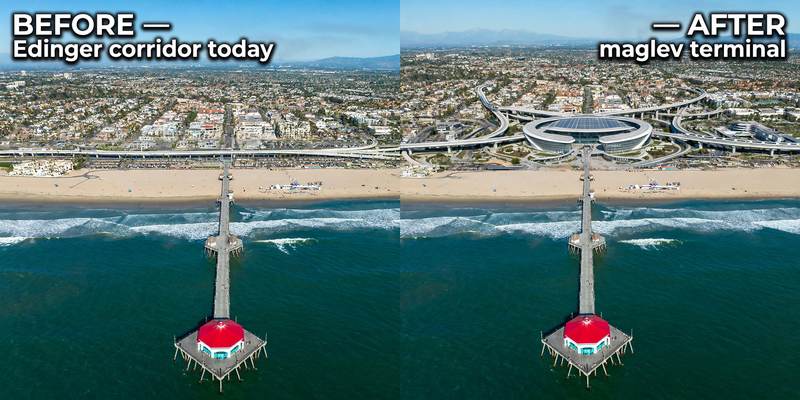
Aerial mock-up (illustrative, not an engineering rendering). Left: the proposed site today. Right: with the maglev terminal.
- Fountain Valley — neighboring suburb on the corridor.
- South Coast Metro edge — Costa Mesa office and retail district.
- Goldenwest district — college and residential area on the approach.