
Transcontinental Links
Fargo, ND
Stop on the proposed 17,000-mile maglev network. Next stop: Sioux Falls, SD (230.0 mi).
About Fargo
Fargo is the most populous city in the U.S. state of North Dakota. The population was 125,990 at the 2020 census and estimated at 136,285 in 2024.
Source: Wikipedia summary (full article). Population and facts as published there.
Cost breakdown (proposal-scale estimates — see math)
⚠️ All figures below are parametric estimates scaled from the proposal's own budget ($8.5T ÷ 17,000 mi ≈ $500M per mile), not engineering quotes. Methodology is shown so you can check the math.
| Item | Basis | Estimate |
|---|---|---|
| Terminal construction | Mid-size city terminal (parametric range $1–2B) | $1.5B |
| Land acquisition | Regional factor 0.7× on $200M base | $140M |
| Track: Fargo → Sioux Falls | 230.0 mi × $500M/mi | $115.0B |
| Annual operations (share) | Staffing, power, maintenance | $30M/yr |
| Stop total (excl. annual ops) | $116.6B |
Best terminal location (proposed)
The downtown Great Northern depot district. Fargo's Great Northern depot still serves Amtrak's Empire Builder in a downtown built around the railroad. The surrounding warehouse district holds redevelopment parcels, and the site anchors the region's largest city at the Red River crossing.
Before / after
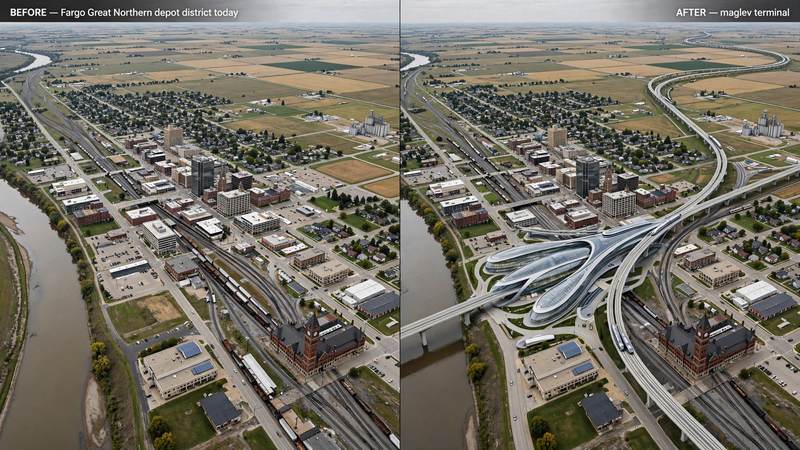
Aerial mock-up (illustrative, not an engineering rendering). Left: the proposed site today. Right: with the maglev terminal.
🛤️ Infill stops toward Sioux Falls: the proposal envisions more stops than cities — smaller stations between majors. Plausible infills on this leg:
← All 287 stops
- Wahpeton, ND — border college town (NDSCS).
- The Horace corridor — south-metro growth area.
- West Fargo, ND — large suburb on the corridor.