
Sioux Falls, SD
Stop on the proposed 17,000-mile maglev network. Next stop: Fargo, ND (230.0 mi).
About Sioux Falls
Sioux Falls is the most populous city in the U.S. state of South Dakota. It is the county seat of Minnehaha County and also extends into northern Lincoln County.
Source: Wikipedia summary (full article). Population and facts as published there.
Cost breakdown (proposal-scale estimates — see math)
| Item | Basis | Estimate |
|---|---|---|
| Terminal construction | Mid-size city terminal (parametric range $1–2B) | $1.5B |
| Land acquisition | Regional factor 0.7× on $200M base | $140M |
| Track: Sioux Falls → Fargo | 230.0 mi × $500M/mi | $115.0B |
| Annual operations (share) | Staffing, power, maintenance | $30M/yr |
| Stop total (excl. annual ops) | $116.6B |
Best terminal location (proposed)
A greenfield site at the I-29 / I-90 interchange (north Sioux Falls). The I-29/I-90 crossroads is the region's highway heart, with flat greenfield land on the north side still available. A terminal here intercepts traffic from three states' worth of catchment — the Dakotas, Minnesota, and Iowa — at the region's largest city.
Before / after
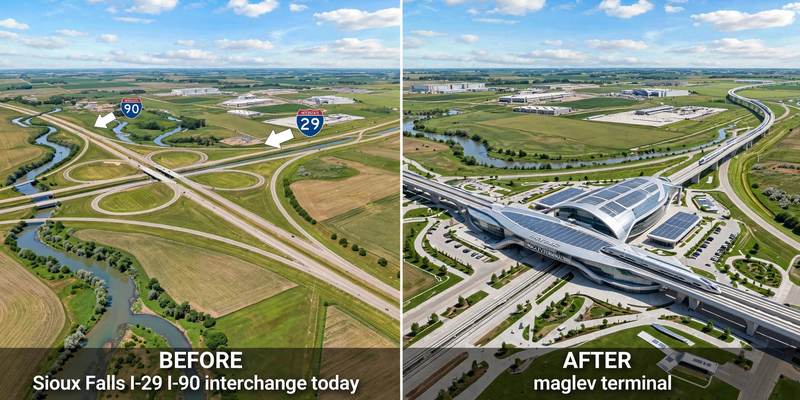
Aerial mock-up (illustrative, not an engineering rendering). Left: the proposed site today. Right: with the maglev terminal.
- Brookings, SD — South Dakota State University town on I-29.
- Watertown, SD — Codington County hub.
- Wahpeton, ND — border college town (NDSCS).