
Jersey City, NJ
Stop on the proposed 17,000-mile maglev network. Next stop: New York City, NY (4.0 mi).
About Jersey City
Jersey City is the second-most populous city in the U.S. state of New Jersey, after Newark. It is the county seat of Hudson County, the county's most populous city and its largest by area.
Source: Wikipedia summary (full article). Population and facts as published there.
Cost breakdown (proposal-scale estimates — see math)
| Item | Basis | Estimate |
|---|---|---|
| Terminal construction | Large-city terminal — 1–4M metro ($2–4B range) | $3B |
| Land acquisition | Regional factor 1.5× on $200M base | $300M |
| Track: Jersey City → New York City | 4.0 mi × $500M/mi | $2.0B |
| Annual operations (share) | Staffing, power, maintenance | $60M/yr |
| Stop total (excl. annual ops) | $5.3B |
Best terminal location (proposed)
the Journal Square district. The PATH hub offers a one-seat ride to Manhattan, and the surrounding residential towers supply enormous walk-up ridership. The waterfront alternative at Exchange Place sits minutes east. It captures Hudson County's half-million residents plus reverse commuters.
Before / after
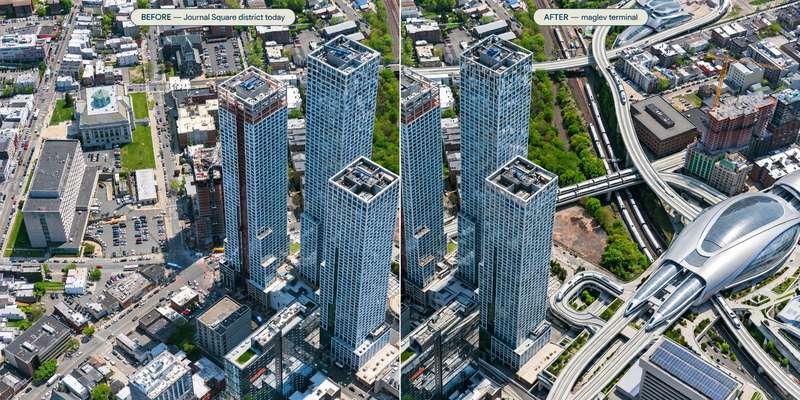
Aerial mock-up (illustrative, not an engineering rendering). Left: the proposed site today. Right: with the maglev terminal.
- Newport district — Jersey City waterfront on the Hudson.
- Hoboken — riverfront city, PATH-connected.
- Hudson Yards approach — Manhattan-side district across the river.