
New York City, NY
Stop on the proposed 17,000-mile maglev network. Next stop: Jersey City, NJ (4.0 mi).
About New York City
New York, often called New York City (NYC), is the most populous city in the United States. It is located at the southern tip of New York State on New York Harbor, one of the world's largest natural harbors. The city comprises five boroughs—Manhattan, Brooklyn, Queens, the Bronx, and Staten Island—each being coextensive with its respective county.
Source: Wikipedia summary (full article). Population and facts as published there.
Cost breakdown (proposal-scale estimates — see math)
| Item | Basis | Estimate |
|---|---|---|
| Terminal construction | Major hub terminal — top-10 US metro ($4–8B range) | $6B |
| Land acquisition | Regional factor 1.5× on $200M base | $300M |
| Track: New York City → Jersey City | 4.0 mi × $500M/mi | $2.0B |
| Annual operations (share) | Staffing, power, maintenance | $120M/yr |
| Stop total (excl. annual ops) | $8.3B |
Best terminal location (proposed)
the Moynihan Train Hall / Penn Station district. The busiest rail hub in the Western Hemisphere already connects Amtrak, LIRR, NJ Transit and half the subway system. Far West Side air-rights development shows vertical capacity exists. No catchment in America matches Midtown Manhattan's — this is the network's gravitational center.
Before / after
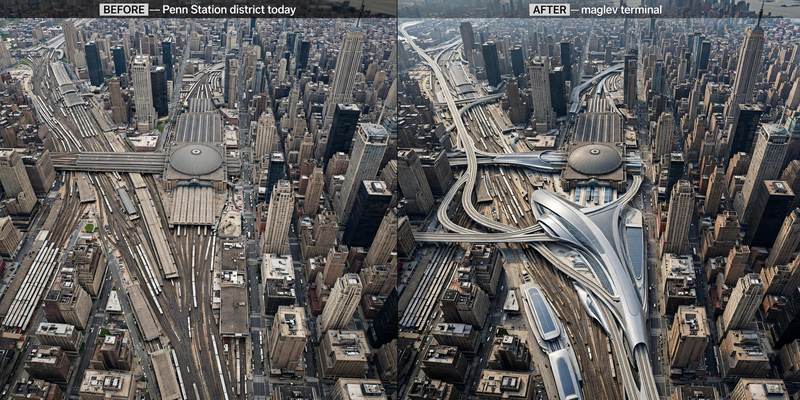
Aerial mock-up (illustrative, not an engineering rendering). Left: the proposed site today. Right: with the maglev terminal.
- Hoboken — Hudson riverfront city, PATH-connected.
- Exchange Place district — Jersey City's financial hub on the waterfront.
- Liberty State Park area — waterfront district at the Jersey City approach.