
Kansas City, KS
Stop on the proposed 17,000-mile maglev network. Next stop: Kansas City, MO (2.7 mi).
About Kansas City
Kansas City, abbreviated KC or KCMO, is the largest city in the U.S. state of Missouri by both population and area. It is located on the Missouri River at its confluence with the Kansas River, within Jackson, Clay, Platte and Cass counties.
Source: Wikipedia summary (full article). Population and facts as published there.
Cost breakdown (proposal-scale estimates — see math)
| Item | Basis | Estimate |
|---|---|---|
| Terminal construction | Mid-size terminal (parametric range $1-2B) | $1.5B |
| Land acquisition | Regional factor 1× on $200M base | $200M |
| Track: Kansas City → Kansas City | 2.7 mi × $500M/mi | $1.35B |
| Annual operations (share) | Staffing, power, maintenance | $30M/yr |
| Stop total (excl. annual ops) | $3.05B |
Best terminal location (proposed)
The downtown Kansas City, Kansas riverfront district. Downtown KCK sits at the confluence of the Kansas and Missouri rivers with the 7th Street corridor and former Union Station approaches running through it. A terminal here serves the Kansas-side metro directly and connects across the river to the Missouri-side Union Station hub.
Before / after
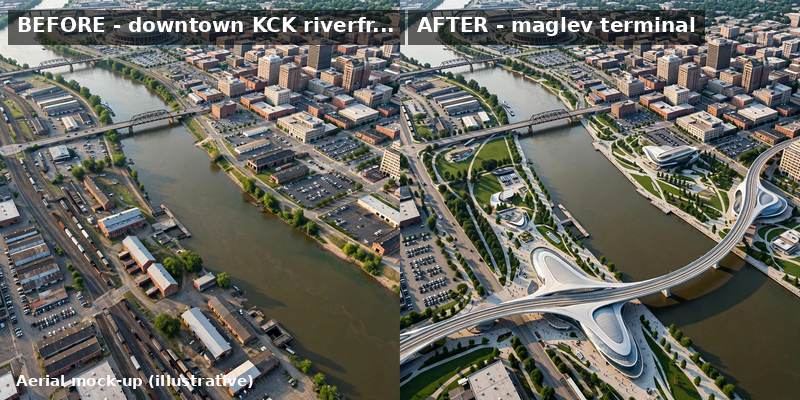
Aerial mock-up (illustrative, not an engineering rendering). Left: the proposed site today. Right: with the maglev terminal.
- Strawberry Hill, Kansas City, KS - bluff neighborhood above the river
- West Bottoms, Kansas City, MO - historic district at the river crossing
- Corridor note: no separate towns fit - the two downtowns are 2.7 miles apart, so any infill would be a neighborhood station