
Lansing, MI
Stop on the proposed 17,000-mile maglev network. Next stop: Flint, MI (48.0 mi).
About Lansing
Lansing is the capital city of the U.S. state of Michigan. It is the sixth-most populous city in Michigan with a population of 112,644 as of the 2020 census, and is the most populous city in Ingham County, though parts of the city extend into Eaton and Clinton counties.
Source: Wikipedia summary (full article). Population and facts as published there.
Cost breakdown (proposal-scale estimates — see math)
| Item | Basis | Estimate |
|---|---|---|
| Terminal construction | Mid-size terminal (parametric range $1-2B) | $1.5B |
| Land acquisition | Regional factor 1× on $200M base | $200M |
| Track: Lansing → Flint | 48.0 mi × $500M/mi | $24B |
| Annual operations (share) | Staffing, power, maintenance | $30M/yr |
| Stop total (excl. annual ops) | $25.7B |
Best terminal location (proposed)
The REO Town district near the former Union Station. Lansing's REO Town sits beside the former Union Station with active rail approaches running through it, and the district's breweries and shops already draw evening crowds. The state capitol and Michigan State's orbit are minutes away, concentrating government and university ridership.
Before / after
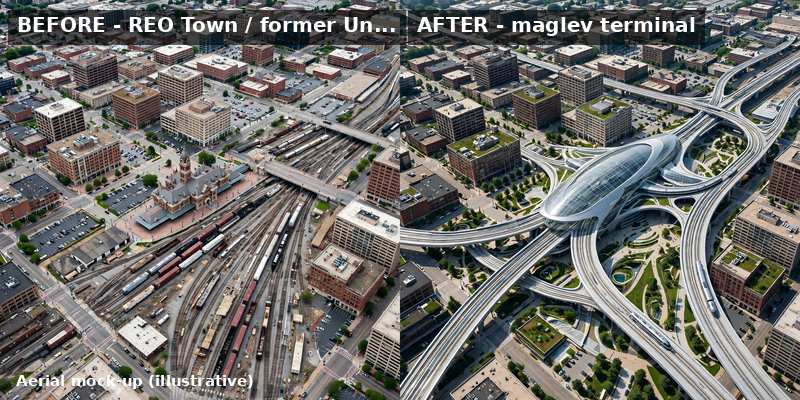
Aerial mock-up (illustrative, not an engineering rendering). Left: the proposed site today. Right: with the maglev terminal.
- Perry, MI - Shiawassee County village on the corridor
- Durand, MI - historic railroad town on the route
- Owosso, MI - Shiawassee County city on the corridor