
Las Vegas, NV
Stop on the proposed 17,000-mile maglev network. Next stop: North Las Vegas, NV (6.7 mi).
About Las Vegas
Las Vegas, colloquially shortened to Vegas, is the most populous city in the U.S. state of Nevada and the county seat of Clark County. It is the 24th-most populous city in the United States, with 641,903 residents at the 2020 census. The Las Vegas metropolitan area has an estimated 2.4 million residents and is the 29th-largest metropolitan area in the country.
Source: Wikipedia summary (full article). Population and facts as published there.
Cost breakdown (proposal-scale estimates — see math)
| Item | Basis | Estimate |
|---|---|---|
| Terminal construction | Large-city terminal ($2–4B range) | $3.0B |
| Land acquisition | Regional factor 1.0× on $200M base | $200M |
| Track: Las Vegas → North Las Vegas | 6.7 mi × $500M/mi | $3.4B |
| Annual operations (share) | 2% of $3.0B terminal | $60M/yr |
| Stop total (excl. annual ops) | $6.6B |
Best terminal location (proposed)
The downtown Las Vegas Union Plaza district. Downtown Las Vegas — not the Strip — is where the region's transit converges: the RTC transit center and the existing Union Plaza rail site. Redevelopment parcels around Cashman Center offer room without tunneling under billion-dollar casino foundations. The catchment is the Strip's 300,000+ hospitality workers plus downtown residents, with far cheaper land than the resort corridor.
Before / after
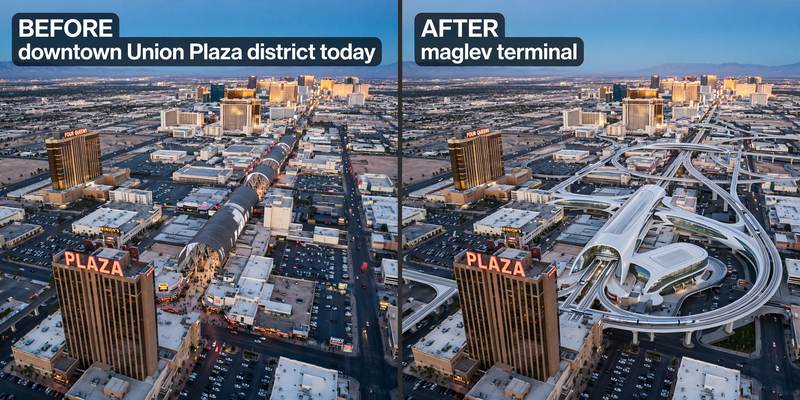
Aerial mock-up (illustrative, not an engineering rendering). Left: the proposed site today. Right: with the maglev terminal.
- The Strat corridor — north Strip district transitioning from motels to mid-rise.
- Fremont East / Arts District — downtown's entertainment and arts core.
- Cashman Field area — downtown-adjacent redevelopment zone.