
Little Rock, AR
Stop on the proposed 17,000-mile maglev network. Next stop: Memphis, TN (129.9 mi).
About Little Rock
Little Rock is the capital and most populous city of the U.S. state of Arkansas. The population was 202,591 at the 2020 census, while the Little Rock metropolitan area with an estimated 770,000 residents is the 81st-most populous metropolitan area in the United States.
Source: Wikipedia summary (full article). Population and facts as published there.
Cost breakdown (proposal-scale estimates — see math)
| Item | Basis | Estimate |
|---|---|---|
| Terminal construction | Mid-size city terminal (parametric range $1–2B) | $1.5B |
| Land acquisition | Regional factor 1.0× on $200M base | $200M |
| Track: Little Rock → Memphis | 129.9 mi × $500M/mi | $65.0B |
| Annual operations (share) | Staffing, power, maintenance | $30M/yr |
| Stop total (excl. annual ops) | $66.7B |
Best terminal location (proposed)
The River Market / Clinton Avenue corridor near the Amtrak station. Little Rock's Amtrak station sits at the foot of the Clinton Presidential Center in the River Market district, with the Rock Region Metro streetcar at the door. The surrounding east-downtown industrial blocks are the city's main redevelopment frontier, and the site straddles the I-30 river crossing.
Before / after
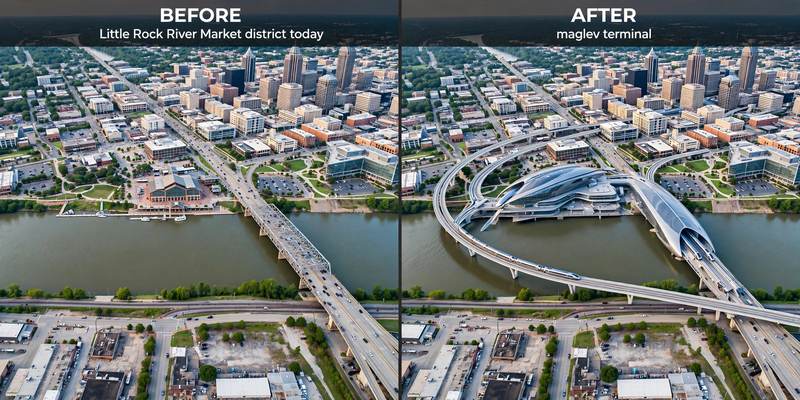
Aerial mock-up (illustrative, not an engineering rendering). Left: the proposed site today. Right: with the maglev terminal.
- Lonoke, AR — county seat on the I-40 corridor.
- Brinkley, AR — delta town at the US-49 junction.
- Forrest City, AR — Crowley's Ridge hub.