
Memphis, TN
Stop on the proposed 17,000-mile maglev network. Next stop: Little Rock, AR (129.9 mi).
About Memphis
Memphis is a city in Shelby County, Tennessee, United States, and its county seat. Situated along the Mississippi River, it had a population of 633,104 at the 2020 census, making it the second-most populous city in Tennessee, the fifth-most populous in the Southeast, and the 29th-most populous in the US. While being the most populous single municipality on the Mississippi River, Memphis anchors the third largest metropolitan area by population behind only the Twin Cities and St.
Source: Wikipedia summary (full article). Population and facts as published there.
Cost breakdown (proposal-scale estimates — see math)
| Item | Basis | Estimate |
|---|---|---|
| Terminal construction | Large-city terminal (parametric range $2–4B) | $3B |
| Land acquisition | Regional factor 1.5× on $200M base | $300M |
| Track: Memphis → Little Rock | 129.9 mi × $500M/mi | $65.0B |
| Annual operations (share) | Staffing, power, maintenance | $60M/yr |
| Stop total (excl. annual ops) | $68.2B |
Best terminal location (proposed)
The Central Station district in South Main. Memphis Central Station is the city's living Amtrak hub, redeveloped with a hotel and the trolley line at its door, in a downtown district already oriented around rail. Building the maglev terminal here reuses an intermodal site the city has already invested in and captures Beale Street and downtown demand.
Before / after
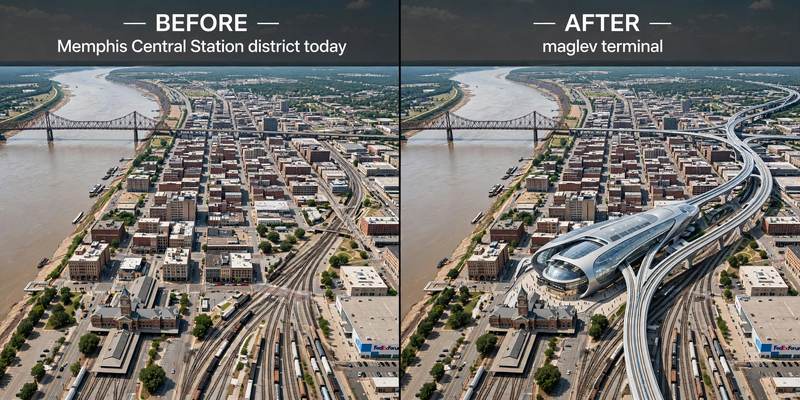
Aerial mock-up (illustrative, not an engineering rendering). Left: the proposed site today. Right: with the maglev terminal.
- West Memphis, AR — Arkansas-side suburb at the I-40 Mississippi crossing.
- Forrest City, AR — Crowley's Ridge town on the I-40 corridor.
- Brinkley, AR — small delta town at the US-49/I-40 junction.