
Long Beach, CA
Stop on the proposed 17,000-mile maglev network. Next stop: Torrance, CA (9.6 mi).
About Long Beach
Long Beach is a coastal city in southeastern Los Angeles County, California, United States. It is the 44th-most populous city in the United States, with a population of 450,469 as of 2025. A charter city, Long Beach is the 7th-most populous city in California, the 2nd-most populous city in Los Angeles County, and the largest city in California that is not a county seat.
Source: Wikipedia summary (full article). Population and facts as published there.
Cost breakdown (proposal-scale estimates — see math)
| Item | Basis | Estimate |
|---|---|---|
| Terminal construction | Large-city terminal ($2–4B range) | $3.0B |
| Land acquisition | Regional factor 1.5× on $200M base | $300M |
| Track: Long Beach → Torrance | 9.6 mi × $500M/mi | $4.8B |
| Annual operations (share) | 2% of $3.0B terminal | $60M/yr |
| Stop total (excl. annual ops) | $8.1B |
Best terminal location (proposed)
The downtown Long Beach Transit Mall district. The Transit Mall is the southern terminus of the Metro A Line, with Long Beach Transit's bus network radiating from it. Waterfront redevelopment parcels near the port offer buildable land a short walk from downtown towers. The catchment combines downtown jobs, CSULB, and the port complex — the busiest container port in the US — whose logistics workforce travels regionally every day.
Before / after
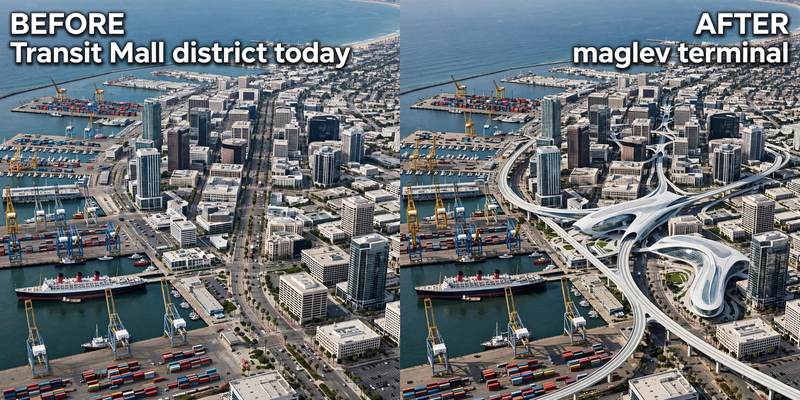
Aerial mock-up (illustrative, not an engineering rendering). Left: the proposed site today. Right: with the maglev terminal.
- Signal Hill — oil-field hilltop city entirely surrounded by Long Beach.
- Carson — industrial city on the 405 corridor.
- Wilmington — LA port-adjacent neighborhood on the approach.