
Los Angeles, CA
Stop on the proposed 17,000-mile maglev network. Next stop: Glendale, CA (7.0 mi).
About Los Angeles
Los Angeles is the most populous city in the U.S. state of California, and the commercial, financial, and cultural center of Southern California. With an estimated 3.87 million residents within the city limits as of 2025, it is the second-most populous city in the United States, behind New York City, and the largest city in the Western United States. The city has an ethnically and culturally diverse population, and is the principal city of a metropolitan area of 12.9 million people (2024).
Source: Wikipedia summary (full article). Population and facts as published there.
Cost breakdown (proposal-scale estimates — see math)
| Item | Basis | Estimate |
|---|---|---|
| Terminal construction | Major hub terminal ($4–8B range) | $6.0B |
| Land acquisition | Regional factor 1.5× on $200M base | $300M |
| Track: Los Angeles → Glendale | 7.0 mi × $500M/mi | $3.5B |
| Annual operations (share) | 2% of $6.0B terminal | $120M/yr |
| Stop total (excl. annual ops) | $9.8B |
Best terminal location (proposed)
The Los Angeles Union Station district. The existing Union Station is already the West's busiest intercity rail hub — Amtrak, Metrolink, and Metro B/D/L lines converge here. Its rail yards and parking aprons offer the only downtown-adjacent land parcels big enough for a maglev terminal without demolishing city blocks. The catchment is the entire LA Basin: ~10 million people within a 30-minute transit ride.
Before / after
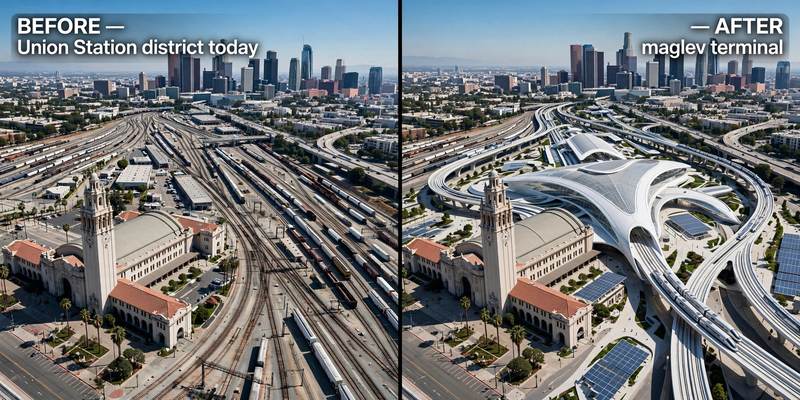
Aerial mock-up (illustrative, not an engineering rendering). Left: the proposed site today. Right: with the maglev terminal.
- Cypress Park — LA neighborhood at the I-5/110 confluence, dense and transit-hungry.
- Glassell Park — hillside LA neighborhood along the LA River rail corridor.
- Atwater Village — neighborhood on the Glendale Blvd corridor between the two hubs.