
Miami, FL
Stop on the proposed 17,000-mile maglev network. Next stop: Hialeah, FL (5.8 mi).
About Miami
Miami is a coastal city in the southeast portion of the U.S. state of Florida. It is the second-most populous city proper in Florida, with a population of 442,241 at the 2020 census. The Miami metropolitan area in South Florida has an estimated 6.39 million residents, ranking as the fifth-largest metropolitan area in the Southeast and eighth-largest metropolitan area in the United States.
Source: Wikipedia summary (full article). Population and facts as published there.
Cost breakdown (proposal-scale estimates — see math)
| Item | Basis | Estimate |
|---|---|---|
| Terminal construction | Major hub — metro tier (range $4–8B) | $6B |
| Land acquisition | Regional factor 1.5× on $200M base | $300M |
| Track: Miami → Hialeah | 5.8 mi × $500M/mi | $2.9B |
| Annual operations (share) | Staffing, power, maintenance | $120M/yr |
| Stop total (excl. annual ops) | $9.2B |
Best terminal location (proposed)
MiamiCentral in downtown Miami. MiamiCentral is already the southern terminus of Brightline and a hub for Metrorail, Metromover, and Tri-Rail, making it the only site where the maglev could plug into every existing transit layer. The downtown catchment is the densest in the Southeast, and the terminal would give air travelers a one-seat ride toward the airport via the MIA Mover connection.
Before / after
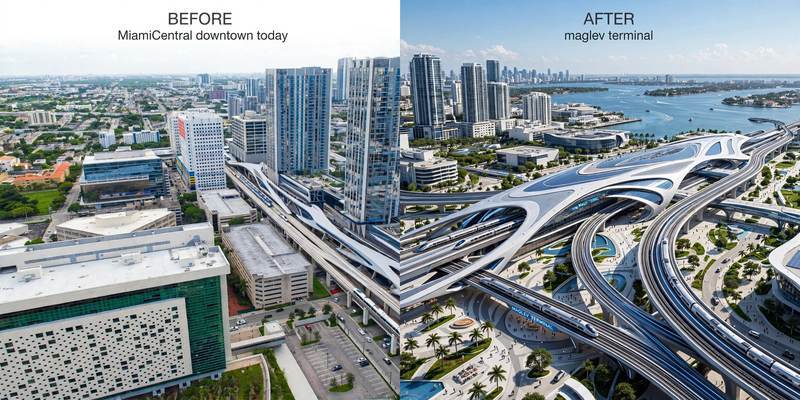
Aerial mock-up (illustrative, not an engineering rendering). Left: the proposed site today. Right: with the maglev terminal.
- Allapattah (Miami) — industrial-residential district on the corridor.
- West Little River — unincorporated community between Miami and Hialeah.
- The Miami River district — warehouse corridor with existing rail rights-of-way.