
Minneapolis, MN
Stop on the proposed 17,000-mile maglev network. Next stop: Saint Paul, MN (8.9 mi).
About Minneapolis
Minneapolis is a city in Hennepin County, Minnesota, United States, and its county seat. With a population of 429,954 as of the 2020 census, it is the state's most populous city. Located in the state's center near the eastern border, it occupies both banks of the Upper Mississippi River and adjoins Saint Paul, the state capital of Minnesota.
Source: Wikipedia summary (full article). Population and facts as published there.
Cost breakdown (proposal-scale estimates — see math)
| Item | Basis | Estimate |
|---|---|---|
| Terminal construction | Large-city terminal (parametric range $2-4B) | $3B |
| Land acquisition | Regional factor 1.5× on $200M base | $300M |
| Track: Minneapolis → Saint Paul | 8.9 mi × $500M/mi | $4.45B |
| Annual operations (share) | Staffing, power, maintenance | $60M/yr |
| Stop total (excl. annual ops) | $7.75B |
Best terminal location (proposed)
The North Loop intermodal district by Target Field. Target Field station already converges the Blue and Green light-rail lines, Northstar commuter rail, and bus routes - the region's one true transit hub. Warehouse-district parcels and rail yard edges around it can host a terminal without touching the ballpark, and downtown's job density is the metro's largest.
Before / after
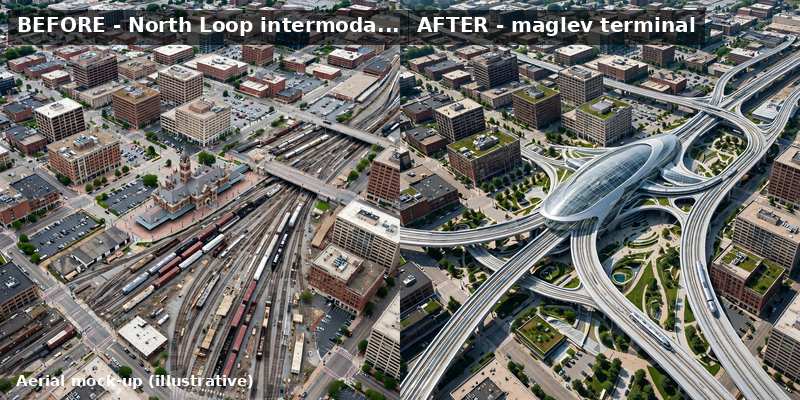
Aerial mock-up (illustrative, not an engineering rendering). Left: the proposed site today. Right: with the maglev terminal.
- Prospect Park, Minneapolis - neighborhood on the University Avenue corridor
- University of Minnesota - Twin Cities campus district on the Green Line
- Midway, Saint Paul - district anchored by the existing Green Line