
Saint Paul, MN
Stop on the proposed 17,000-mile maglev network. Next stop: Minneapolis, MN (8.9 mi).
About Saint Paul
Paul, commonly known as Paul the Apostle or Saint Paul, was a Christian apostle who spread the teachings of Jesus in the first century AD. For his contributions towards the New Testament, he is generally regarded as one of the most important figures of the Apostolic Age, and he also founded several Christian communities in Asia Minor and Europe from the mid-40s to the mid-50s AD.
Source: Wikipedia summary (full article). Population and facts as published there.
Cost breakdown (proposal-scale estimates — see math)
| Item | Basis | Estimate |
|---|---|---|
| Terminal construction | Large-city terminal (parametric range $2-4B) | $3B |
| Land acquisition | Regional factor 1.5× on $200M base | $300M |
| Track: Saint Paul → Minneapolis | 8.9 mi × $500M/mi | $4.45B |
| Annual operations (share) | Staffing, power, maintenance | $60M/yr |
| Stop total (excl. annual ops) | $7.75B |
Best terminal location (proposed)
The Union Depot district in Lowertown. Saint Paul's restored Union Depot already serves Amtrak, intercity buses, and the Green Line light rail - the east metro's intermodal anchor. Lowertown's historic warehouse blocks and nearby surface lots offer terminal room, and the depot's event and office spaces prove the building can carry more than trains.
Before / after
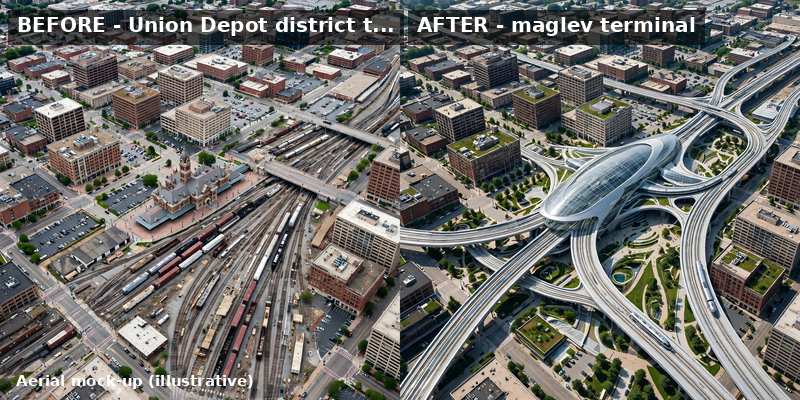
Aerial mock-up (illustrative, not an engineering rendering). Left: the proposed site today. Right: with the maglev terminal.
- Midway, Saint Paul - district anchored by the existing Green Line
- University of Minnesota - Twin Cities campus district on the Green Line
- Prospect Park, Minneapolis - neighborhood on the University Avenue corridor