
New Orleans, LA
Stop on the proposed 17,000-mile maglev network. Next stop: Baton Rouge, LA (72.8 mi).
About New Orleans
New Orleans is a consolidated city-parish located along the Mississippi River in the U.S. state of Louisiana. With a population of 383,997 at the 2020 census, New Orleans is the most populous city in Louisiana, the second-most populous in the Deep South, and the twelfth-most populous in the Southeastern United States; the New Orleans metropolitan area, with about 1 million residents, is the 59th-most populous metropolitan area in the United States.
Source: Wikipedia summary (full article). Population and facts as published there.
Cost breakdown (proposal-scale estimates — see math)
| Item | Basis | Estimate |
|---|---|---|
| Terminal construction | Large-city terminal (parametric range $2–4B) | $3B |
| Land acquisition | Regional factor 1.5× on $200M base | $300M |
| Track: New Orleans → Baton Rouge | 72.8 mi × $500M/mi | $36.4B |
| Annual operations (share) | Staffing, power, maintenance | $60M/yr |
| Stop total (excl. annual ops) | $39.7B |
Best terminal location (proposed)
The Union Passenger Terminal district. Union Passenger Terminal already hosts Amtrak's City of New Orleans, Crescent, and Sunset Limited plus Greyhound, with RTA streetcar and bus connections at the door. It is the Gulf Coast's established intercity rail site, and the adjacent rail yards leave room for a maglev hall beside the historic headhouse.
Before / after
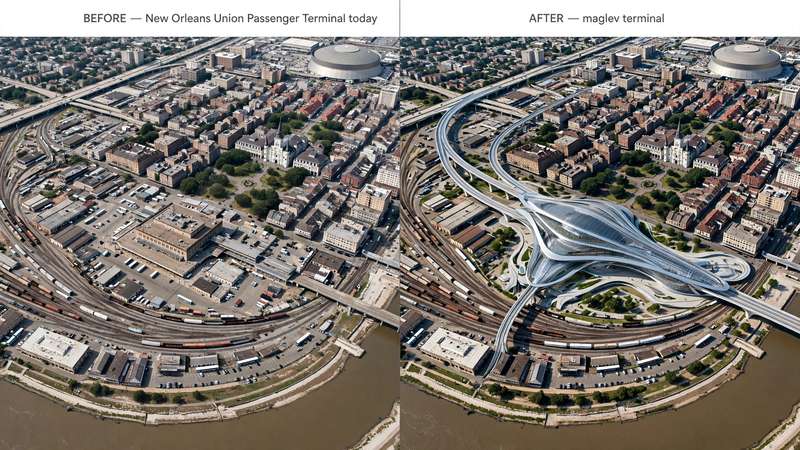
Aerial mock-up (illustrative, not an engineering rendering). Left: the proposed site today. Right: with the maglev terminal.
- Metairie, LA — large Jefferson Parish suburb west of the city.
- LaPlace, LA — St. John Parish town on the I-10 corridor.
- Gonzales, LA — Ascension Parish hub on the route to Baton Rouge.