
Portland, OR
Stop on the proposed 17,000-mile maglev network. Next stop: Vancouver, WA (8.0 mi).
About Portland
Portland is the most populous city in the U.S. state of Oregon. Located in the Pacific Northwest at the confluence of the Willamette and Columbia rivers, it is the 28th-most populous city in the United States, sixth-most populous on the West Coast, and fourth-most populous in the Pacific Northwest, with a population of 652,503 at the 2020 census. The Portland metropolitan area, with over 2.54 million residents, is the 26th-largest metropolitan area in the nation.
Source: Wikipedia summary (full article). Population and facts as published there.
Cost breakdown (proposal-scale estimates — see math)
| Item | Basis | Estimate |
|---|---|---|
| Terminal construction | Large-city terminal ($2–4B range) | $3.0B |
| Land acquisition | Regional factor 1.5× on $200M base | $300M |
| Track: Portland → Vancouver | 8.0 mi × $500M/mi | $4.0B |
| Annual operations (share) | 2% of $3.0B terminal | $60M/yr |
| Stop total (excl. annual ops) | $7.3B |
Best terminal location (proposed)
The Union Station district. Portland's Union Station already hosts Amtrak Cascades and the Empire Builder, with MAX light rail and the streetcar stopping outside. The rail-yard corridor north of the station is one of the few contiguous buildable strips near downtown. The Pearl District and Broadway business core put the region's densest housing and jobs within walking distance.
Before / after
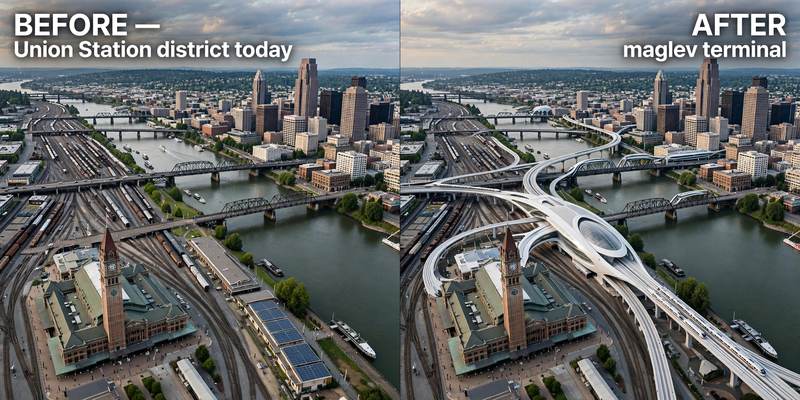
Aerial mock-up (illustrative, not an engineering rendering). Left: the proposed site today. Right: with the maglev terminal.
- Hayden Island — island neighborhood on I-5 at the Oregon-Washington line.
- Jantzen Beach — riverside commercial area on Hayden Island.
- Kenton — North Portland industrial neighborhood on the approach corridor.