
Providence, RI
Stop on the proposed 17,000-mile maglev network. Next stop: Worcester, MA (36.3 mi).
About Providence
Providence is the capital and most populous city of the U.S. state of Rhode Island. It is the third-most populous city in New England, with a population of 190,934 at the 2020 census.
Source: Wikipedia summary (full article). Population and facts as published there.
Cost breakdown (proposal-scale estimates — see math)
| Item | Basis | Estimate |
|---|---|---|
| Terminal construction | Large-city terminal — 1–4M metro ($2–4B range) | $3B |
| Land acquisition | Regional factor 1.5× on $200M base | $300M |
| Track: Providence → Worcester | 36.3 mi × $500M/mi | $18.1B |
| Annual operations (share) | Staffing, power, maintenance | $60M/yr |
| Stop total (excl. annual ops) | $21.4B |
Best terminal location (proposed)
the Providence Station / State House district. The existing Amtrak and MBTA hub sits beneath the State House with Kennedy Plaza bus connections steps away. It captures the Providence metro plus southeastern Massachusetts commuters who already ride the Providence Line. Downtown's compact grid makes walk-up ridership strong.
Before / after
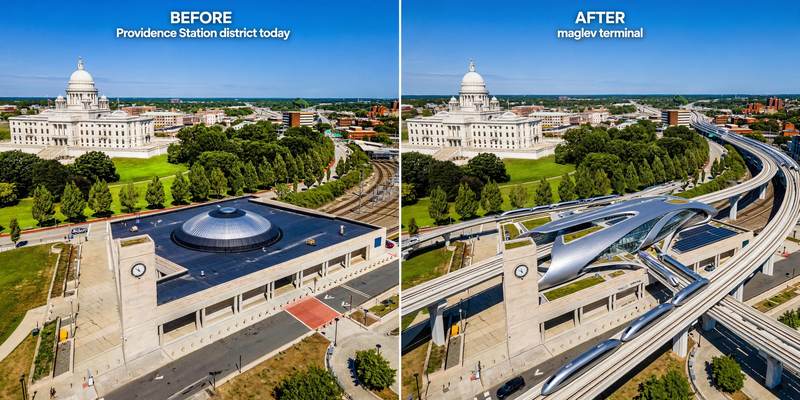
Aerial mock-up (illustrative, not an engineering rendering). Left: the proposed site today. Right: with the maglev terminal.
- Woonsocket — city on the RI-146 corridor north.
- Cumberland — town on the alignment toward Massachusetts.
- Northbridge — town at the Worcester approach.