
Richmond, VA
Stop on the proposed 17,000-mile maglev network. Next stop: Newport News, VA (61.5 mi).
About Richmond
Richmond is the capital city of the U.S. state of Virginia. Incorporated in 1742, Richmond has been an independent city since 1871. It is the fourth-most populous city in Virginia, with a population of 226,610 at the 2020 census.
Source: Wikipedia summary (full article). Population and facts as published there.
Cost breakdown (proposal-scale estimates — see math)
| Item | Basis | Estimate |
|---|---|---|
| Terminal construction | Large city — metro tier (range $2–4B) | $3B |
| Land acquisition | Regional factor 1.5× on $200M base | $300M |
| Track: Richmond → Newport News | 61.5 mi × $500M/mi | $30.8B |
| Annual operations (share) | Staffing, power, maintenance | $60M/yr |
| Stop total (excl. annual ops) | $34B |
Best terminal location (proposed)
The Main Street Station / Shockoe Bottom district. Main Street Station is Richmond's historic downtown rail terminal with Amtrak service and surrounding Shockoe Bottom redevelopment parcels. The site sits on the natural Northeast–Southeast rail corridor, serving the state capital and giving VCU and downtown employers a walk-up station.
Before / after
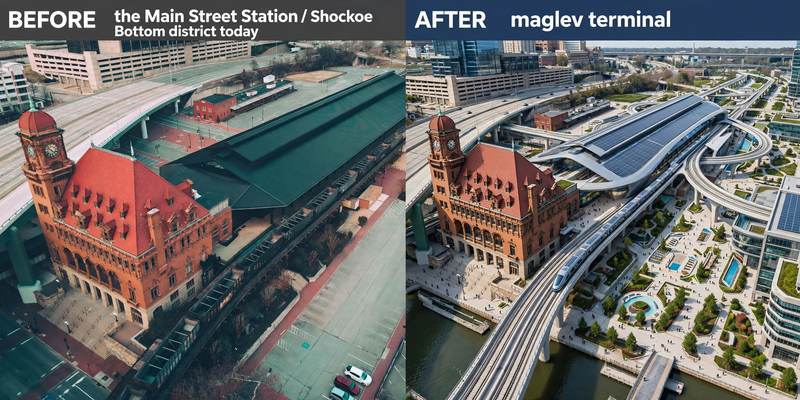
Aerial mock-up (illustrative, not an engineering rendering). Left: the proposed site today. Right: with the maglev terminal.
- Mechanicsville, VA — Hanover County suburb on US-360.
- Williamsburg, VA — colonial tourism hub on I-64.
- New Kent, VA — county seat on the I-64 corridor.