
Sacramento, CA
Stop on the proposed 17,000-mile maglev network. Next stop: Elk Grove, CA (13.7 mi).
About Sacramento
Sacramento is the capital city of the U.S. state of California. The county seat of Sacramento County, it is located at the confluence of the Sacramento and American Rivers in the Sacramento Valley. It is the fourth-most populous city in Northern California, sixth-most populous city in the state, and 35th-most populous city in the United States, with a population of 524,943 at the 2020 census.
Source: Wikipedia summary (full article). Population and facts as published there.
Cost breakdown (proposal-scale estimates — see math)
| Item | Basis | Estimate |
|---|---|---|
| Terminal construction | Large-city terminal ($2–4B range) | $3.0B |
| Land acquisition | Regional factor 1.5× on $200M base | $300M |
| Track: Sacramento → Elk Grove | 13.7 mi × $500M/mi | $6.8B |
| Annual operations (share) | 2% of $3.0B terminal | $60M/yr |
| Stop total (excl. annual ops) | $10.1B |
Best terminal location (proposed)
The Sacramento Valley Station district. Sacramento Valley Station is the Capitol Corridor's busiest hub and the state's seventh-busiest Amtrak station, with Gold and Blue light-rail lines at its plaza. The adjacent Railyards redevelopment is the largest urban infill site in the country — room for a maglev terminal plus transit-oriented housing. The catchment is state government: tens of thousands of workers traveling to the capital daily.
Before / after
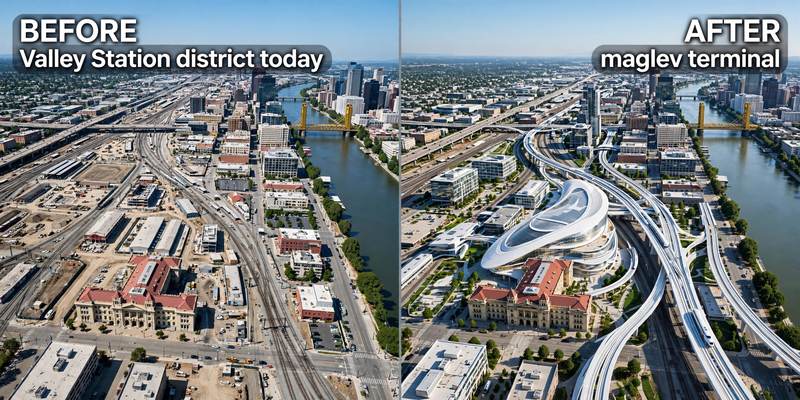
Aerial mock-up (illustrative, not an engineering rendering). Left: the proposed site today. Right: with the maglev terminal.
- Meadowview — South Sacramento light-rail neighborhood.
- Florin corridor — South Sac retail corridor on the southern approach.
- Laguna — north-edge suburb of Elk Grove on the corridor.